DIRECTED BY MARTYN BURKE
MAGNUM PICTURES
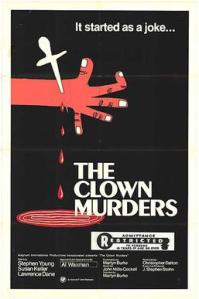 Based around a rather dubious proposition – kidnapping an acquaintance’s wife to prevent him from making a business deal at, uh, the stroke of midnight, or something along those lines – the REAL horror here is in the breakdown of the characters’ shared relationships, man. Oh, and in the revelation of the ugly truths underlying their established personas. Or something along those lines. Only intermittently interesting for some of the glimpses at the dynamics of the power structure within this group of former school chums, events eventually take a dramatic and unexpected turn for the somewhat perverse once the action tips toward and past the climax. (Literally! In at least one sense.) It’s not too hard to figure out the mystery-of-sorts as regards the killer clown(s), but another mystery proves more elusive: what the hell?
WHY DID I WATCH THIS MOVIE?
The title caught my eye, but wouldn’t have convinced me without the summary promise of intrigue, which never developed. A caper undercut by duplicity it did turn out to be, but alas not nearly as interesting as it sounded.
SHOULD YOU WATCH THIS MOVIE?
I’m fairly certain you can find better examples of the basic motifs at work here, albeit probably without the clown costumes.
HIGHLIGHT AND LOW POINT
What really sold me on this flick was that it was one of John Candy’s first major film roles, and not a comedy. Unfortunately, he predictably played a heavier-set gentleman, one of whom’s friends constantly ridicules him about his size; throughout the film, his character is quite often seen eating. Since Candy reputedly had a lifelong struggle with his weight and self-image, and died at 43 because of related health issues, this was kind of a bummer. The turning point in the film, which involves his character, is itself extremely distressing for myriad reasons.
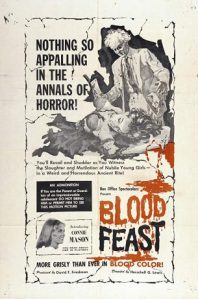 Here is where we should begin our disquisition on the ephemeral nature of what constitutes art vis-à-vis garbage, and engage in deep contemplation on the revealed substance and its relation to the Ideal, and how mere imitation or re-creation can only hope to further distance us from the knowledge of this state of perfection. We should, but we won’t, because gore impresario, auteur loon and marketing maven Herschell Gordon Lewis would probably laugh and point at us. His frankly ridiculous tale of catering a Society party with an “authentic Egyptian Feast” as a hopeful means of reviving the goddess Ishtar via cannibalism features some impossibly wooden acting, hilariously half-assed set dressing, excessively expository dialogue, indubitably fake blood, transparently ersatz makeup and FX, rudimentary cinematography, et cetera et cetera et cetera et cetera. (And in the midst of life we are in debt,
 In which we find the patient suffering from sequelitis, the disease by which little vestige of the original creation still survives, save for symbols and signifiers … such as the titular bogeyman. Strangely (and unfortunately), this installment’s eponym – known this time around as “Junior” (eyeroll) – takes his characterization from the ill-advised second chapter rather than the archetypal original. Since the chainsaw itself barely plays any real role here, aside from an asinine novelty visual, one wonders why they just didn’t make this flick its own generic vehicle rather than further degrade the “franchise.” Other issues abound, of course, not the least of which concerns the edits the film had to make to garner an “R” rating. A slasher movie that doesn’t actually show any gore – hell, only one character is killed in the first hour – is a curious thing, no? And where in the hell is this backward backwoods family getting a new house and all these new relatives, anyway? The genre equivalent of Mike Love’s “Beach Boys” performing postgame concerts in baseball stadiums for decades on end.
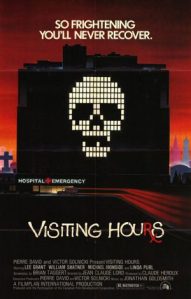 Okay, I imagined this one was gonna be pretty lame, and in fact, I had put off watching it for the past couple years. It kept almost making the cut, but then I’d figure it was gonna be too tame and too much like a soap opera. Instead, it was actually a pretty taut affair, and despite some overly predictable developments, a rewarding choice. (It probably didn’t hurt that none of the other flicks I watched around the same time were much good.) Michael Ironside’s malevolent antihero is an implacable force, ably balancing out the fact that Wm. Shatner kept reminding me of so-called U. S. “president” Don T., through no fault of his own. (Shatner’s, that is.) A few genuinely surprising scenes during the climactic action were a welcome sight. I also found the subject matter, of a female media personality’s taking a stand opposing violence against women and triggering a backlash from a vigilante nutcase, to be very relevant in the current political climate.
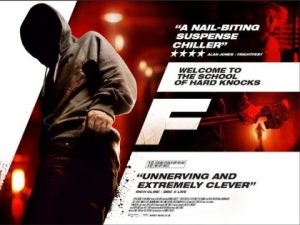 Only about 75 minutes long, this British production is basically Scream meets The Strangers, minus any meta sensibility or any tinge of humor (or humour, if you will). It does feature the very British touch of having one or more of its characters muttering and whispering his or her dialogue so that it’s virtually impossible to hear, especially if you’re watching it with doors and windows open in a neighborhood like mine. (And a sense of hearing like mine.) Also featured: very little detail. We aren’t told much about motivation, relationships, hierarchies. We do get some brief insights from which inferences may be drawn, but are essentially dropped into the middle of someone else’s story without being given a lot of background. What transpires is effectively unsettling, however – in any number of ways – and the ending is pretty intense. The story REALLY needed some new ideas of its own, though.
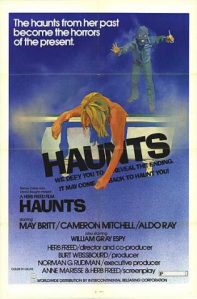 An oddity, this number is mostly a small-town slice-of-life crime thriller until its misleading, byzantine conclusion. Apparently issued on DVD without restoration, it looks terrible, and I was amused to find out its washed-out palette was allegedly purposeful. Aldo Ray as the sheriff is believable in his role, but anything else that’s noteworthy here merely relates to the presentation of a time and a way of life that are both long gone. Its weary, lived-in 1970s feeling kept it interesting for longer than was probably warranted. By the time the goings-on start getting sorted out, they get tangled up again, and you will have lost your patience by this point, particularly with the main character. She’s being stalked! Or maybe she isn’t. The local Casanova is a rapist, perhaps worse! Or IS he. “Better not book him just yet, we got the killer cornered down at the sawmill,” one character telephones. But what of the local parson, the uncle, the goat? The ending, like much of the rest, is a muddle.
 This lousy endeavor became an endurance test of sorts, as I could hardly wait for it to finish taking up my valuable time with its lousy acting, unnatural dialogue, odd tempo and beginner’s camerawork. This
  Rather preposterously set in a “high school” (none of the major student roles is played by anyone under 18, or particularly close), this picture presents an extremely convoluted resolution to an otherwise straightforward, standard horror movie. Sure, as you watch, you know you’re being set up for the SHOCKING ending – hell, the filmmakers tease you with various false reveals along the way – but even so, once all the layers are peeled away, you feel a little incredulous. Skeptical, even. I mean, it all seems like WAY too much trouble for a touch of retribution. The red herrings from the production team combine with similar trickery from the characters themselves to create a film that overall is a bit too intricate. It’s also a bit too long. And in spite of all that, to pull off the ruse, they still had to cheat.
 The rare film with Clint Howard in the lead role, this ridiculous affair resurrects Satan in the guise of “[Father] Estaban” via the use of an Apple III, which in all honestly is fairly prescient, given everything that’s transpired since the rise of the personal computer. (I do not know whether medieval texts have also been involved, as they are in this movie.) Set in a military academy, which oddly enough appears to be affiliated with a religious order, and in orientation not unlike contemporary teen romps such as Meatballs or Porky’s (or Sleepaway Camp, for that matter), this picture is way more entertaining and enjoyable than should have been possible. A major factor in this phenomenon may be Howard’s general ineptitude. Also inept: the terrible editing during the second half of this picture.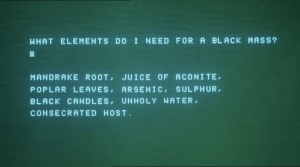
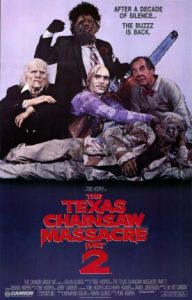 Hey, a new competitor for worst movie on this site! For some reason turning one of the best and most impactful horror movies ever made into an extended bout of broadly drawn “humor,” aggravating characterizations, little plot and no point, TCM2 is a chore to endure. Insulting in its carelessness, this flick only could have been more of a cartoon had The Mystery Machine appeared. (Much of the action takes place in an abandoned amusement park, for crying out loud. Where were the Harlem Globetrotters and Phyllis Diller?) Leatherface – sorry, “Bubba” – is reminiscent of Fred Gwynne as Herman Munster, which is not a compliment, much as Bill Moseley’s horrible character seems to have presaged alleged funnyman Jim Carrey’s equally irritating “Fire Marshall Bill.” (And in actuality was a template for Michael Keaton’s Betelgeuse.) Meanwhile, Dennis Hopper spends the first half of the film not even pretending he gives half a damn and the second half hamming it up wildly. Mr. Hooper allegedly wanted to compensate for the audience’s not recognizing the black humor in the original, but this extremely stupid and classless farce raises the question whether his first attempt was just a happy accident. Also commits the sequel’s sin of reductionism while simultaneously destroying continuity – a hapless combination. And the FX suck, too. Excruciating and disgraceful.
 SPACE RATS From Outer Space