directed by johannes roberts
black robe/capital markets film finance
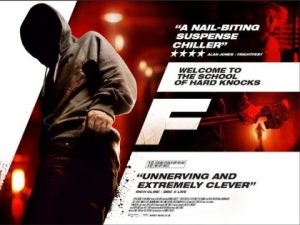 Only about 75 minutes long, this British production is basically Scream meets The Strangers, minus any meta sensibility or any tinge of humor (or humour, if you will). It does feature the very British touch of having one or more of its characters muttering and whispering his or her dialogue so that it’s virtually impossible to hear, especially if you’re watching it with doors and windows open in a neighborhood like mine. (And a sense of hearing like mine.) Also featured: very little detail. We aren’t told much about motivation, relationships, hierarchies. We do get some brief insights from which inferences may be drawn, but are essentially dropped into the middle of someone else’s story without being given a lot of background. What transpires is effectively unsettling, however – in any number of ways – and the ending is pretty intense. The story REALLY needed some new ideas of its own, though.
why did i watch this movie?
The director helmed The Strangers: Prey at Night, which I’d seen recently, so I thought hey, let’s see what else this guy did.
should you watch this movie?
You have received the caveats. Make of them what you will.
highlight and low point
This film is really well done, especially for a production that obviously didn’t cost a whole lot, so the biggest problem it has remains its lack of originality. Except, again, for the ending, which considers a facet of the human condition not often addressed in these types of pictures. The extremely judicious nature of precisely what is shown and when is exceptional.
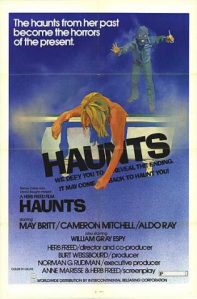 An oddity, this number is mostly a small-town slice-of-life crime thriller until its misleading, byzantine conclusion. Apparently issued on DVD without restoration, it looks terrible, and I was amused to find out its washed-out palette was allegedly purposeful. Aldo Ray as the sheriff is believable in his role, but anything else that’s noteworthy here merely relates to the presentation of a time and a way of life that are both long gone. Its weary, lived-in 1970s feeling kept it interesting for longer than was probably warranted. By the time the goings-on start getting sorted out, they get tangled up again, and you will have lost your patience by this point, particularly with the main character. She’s being stalked! Or maybe she isn’t. The local Casanova is a rapist, perhaps worse! Or IS he. “Better not book him just yet, we got the killer cornered down at the sawmill,” one character telephones. But what of the local parson, the uncle, the goat? The ending, like much of the rest, is a muddle.
 This lousy endeavor became an endurance test of sorts, as I could hardly wait for it to finish taking up my valuable time with its lousy acting, unnatural dialogue, odd tempo and beginner’s camerawork. This
  Rather preposterously set in a “high school” (none of the major student roles is played by anyone under 18, or particularly close), this picture presents an extremely convoluted resolution to an otherwise straightforward, standard horror movie. Sure, as you watch, you know you’re being set up for the SHOCKING ending – hell, the filmmakers tease you with various false reveals along the way – but even so, once all the layers are peeled away, you feel a little incredulous. Skeptical, even. I mean, it all seems like WAY too much trouble for a touch of retribution. The red herrings from the production team combine with similar trickery from the characters themselves to create a film that overall is a bit too intricate. It’s also a bit too long. And in spite of all that, to pull off the ruse, they still had to cheat.
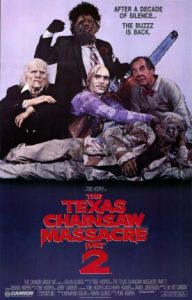 Hey, a new competitor for worst movie on this site! For some reason turning one of the best and most impactful horror movies ever made into an extended bout of broadly drawn “humor,” aggravating characterizations, little plot and no point, TCM2 is a chore to endure. Insulting in its carelessness, this flick only could have been more of a cartoon had The Mystery Machine appeared. (Much of the action takes place in an abandoned amusement park, for crying out loud. Where were the Harlem Globetrotters and Phyllis Diller?) Leatherface – sorry, “Bubba” – is reminiscent of Fred Gwynne as Herman Munster, which is not a compliment, much as Bill Moseley’s horrible character seems to have presaged alleged funnyman Jim Carrey’s equally irritating “Fire Marshall Bill.” (And in actuality was a template for Michael Keaton’s Betelgeuse.) Meanwhile, Dennis Hopper spends the first half of the film not even pretending he gives half a damn and the second half hamming it up wildly. Mr. Hooper allegedly wanted to compensate for the audience’s not recognizing the black humor in the original, but this extremely stupid and classless farce raises the question whether his first attempt was just a happy accident. Also commits the sequel’s sin of reductionism while simultaneously destroying continuity – a hapless combination. And the FX suck, too. Excruciating and disgraceful.
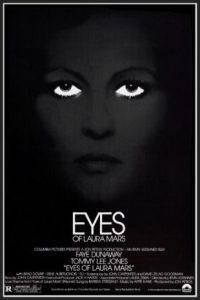 When it comes to mysteries, I’m the quintessential mark. It’s that character! No, that one! Wait, it’s probably her! Every time. How bad is it? I kept waffling about the probable identity of the killer whose dastardly exploits are viewed through Laura’s Eyes, even though this movie is 40 years old and I’ve read about it multiple times. Anyway, this production – written by John Carpenter for his first major film credit – knowingly manipulates its audience with suspenseful close-ups of René Auberjonois, our old pal Brad Dourif, the late Raúl Juliá, and other, less famous actors. Nonetheless, even a major misdirection in the late going doesn’t deter one from deducing the SHOCKING ending, especially as it’s telegraphed shortly beforehand. More “thriller” than “horror,” but it IS chock full o’ murders, death, and images thereof. The maudlin “Prisoner (Love Theme from Eyes of Laura Mars)” blares over the end credits, Barbra Streisand holding nothing back.
 This goofy little B-movie is a good example of what kinds of films this site’s proprietor often prefers. (Why is a different subject.) By rights, it SHOULD be hampered by various difficulties, not the least of which is its ridiculous story, and among which are occasionally lax production values, unconvincing acting and the overall feeling that it’s a made-for-TV affair. Nonetheless, it mostly succeeds, even if it doesn’t quite fulfill any variety of promises suggested when it shifts into the present tense. Coincidences and improbabilities propel the plot, highlighted by the irrepressible Brad Dourif emoting another weirdo and basically causing all the trouble. I didn’t even mention the stirring title anthem that you will probably immediately identify, as I did, as being written and performed by Linda Perry. So what, exactly, works here then, one may well be wondering. Call it pathos; within the outlandish framework resides the tale of a girl searching for family.
 The first thing I noticed about this movie, the sophomore effort from Bob Clark following Children Shouldn’t Play With Dead Things, is how vastly improved in every aspect of filmmaking it is in comparison to that initial offering. Script, lighting, camerawork, acting, pacing, makeup effects – everything is better. It’s as though Clark and head writer Alan Ormsby made a serious study of their inaugural production in order to make a more professional showing with their next film. Whatever the explanation – the budget was almost 400% larger, nearly $240,000! – it worked, because altogether this little horror picture is nearly excellent. The emotional impact of the small-town boy returning from a foreign war and the many repercussions of his impaired condition – to describe it as benignly as possible – are powerfully depicted, and the creeping sense that something is very wrong is deftly developed. Inspired by the W. W. Jacobs story “The Monkey’s Paw,” this saga sure seems to have been bastardized within S. King’s 1983 novel Pet Sematary in the tale of Timmy Baterman. (PERHAPS coincidentally, late in this flick, the action veers into a graveyard identified on its iron gates by a sign bearing the misspelling “Cemetary.”)
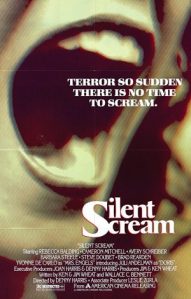 Set in a boarding house, this film is a pretty decent example of the derive-the-killer’s-identity plotline, the basic premise of which was repeated a few years later by
  This not terribly creative small-budget independent slasher-type horror feature is compromised by a few serious issues. One is that it is highly reminiscent of My Bloody Valentine, which wouldn’t be so bad except that it came out nine months later than that flick. The other, which is probably more severe, is that its reveal of the mystery killer isn’t acceptable, being not only illogical but improbable. While I acknowledge that one may not always be able to deduce the slayer’s correct identity in these types of pictures, it’s gotta make SOME kind of sense to support the conceit. And this one just doesn’t. Granted, the conclusion doesn’t even bother to explain anything in the aftermath – which is admirable to some degree – but after dwelling on it for about four seconds, I realized that a number of other details also don’t add up to anything. (One in particular makes absolutely no sense whatsoever.) A false-shock ending is thrown in for additional kicks. I will concede that the song title “Disco Blood” (“Original Rock Music Composed and Performed by NOWHERE FAST”) is A-1.
 SPACE RATS From Outer Space