directed by peter sasdy
“a unicapital production”
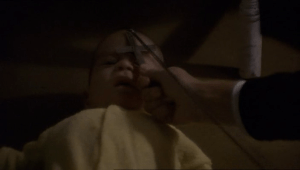
 This British film is absurdly amateurish, and in fact may be one of the most unprofessional movies made by an actual studio that you’re apt to see. It’s all here – ripoff script, the lowest of budgets, random illogic and execrable dramatics. Joan Collins isn’t even the worst actor in this picture, which should really tell you something. One of the characters is a nun, and her fake Italian accent is truly a wonder to behold, especially voicing dialogue such as “Is it possible for a baby not to want to be born?” The performances are so laughable that Donald Pleasence – DONALD PLEASENCE – appears reasonably accomplished with his typically disaffected mien. The absolutely most striking feature here, though, is that the director repetitiously focuses on an ordinary baby lying in its crib (or “pram,” depending on scenario) to illustrate … EVIL. Or something. It is, uh, not effective. Whatever you call this mess, it’s another abominable creation that later became a “camp classic” – although typically part of such (dis)honor is that dreck becomes enjoyable when you’re in on the joke, and this film is not enjoyable for any reason. (By the way, the baby’s mother’s name is Lucy; no Sharon can be found.)
why did i watch this movie?
Long abuse is my excuse.
should you watch this movie?
“Oh, how can I tell the doctor … I think my baby’s possessed by a devil!” This line is delivered by a presumably distraught ex-stripper to her gal pal, with whom she used to work at the cabaret operated by her former (and the gal pal’s current) lover. Luckily, mom’s sister-in-law – the “Italian” nun – will actually be the one to inform the physician, who will listen because, naturally, Sister Albana has a background in Veterinary Science.
highlight and low point
rating from outer space: F
 Now, this is more like it! A tremendously realized mid-’70s fright flick that succeeds without any of the earmarks that would soon begin to plague the genre (slashing, masks, teenagers, etc.), this mainly psychological horror picture draws one in the old-fashioned way. Something’s obviously wrong, seemingly minor issues continuously get more worrisome, the situation keeps deteriorating … but nothing too specific can be identified. (You’ll probably get an inkling, of course.) Tiny hints here and there tiptoe toward the devastating conclusion, and it’s all handled impeccably. Well, truth be told, things get a little out of hand as that ending nears, including some of the performances, but that neither lessens the impact nor diminishes the achievement. The film does almost overstay its welcome; it’s a minor flaw, though exacerbated a bit as the climax nears, as it feels as though substantial cuts must have been made. Oliver Reed is his usual intense self throughout, so that’s a hoot, Karen Black handles a complicated role fairly well, and Bette Davis is excellent.
 The first thing I noticed about this movie, the sophomore effort from Bob Clark following Children Shouldn’t Play With Dead Things, is how vastly improved in every aspect of filmmaking it is in comparison to that initial offering. Script, lighting, camerawork, acting, pacing, makeup effects – everything is better. It’s as though Clark and head writer Alan Ormsby made a serious study of their inaugural production in order to make a more professional showing with their next film. Whatever the explanation – the budget was almost 400% larger, nearly $240,000! – it worked, because altogether this little horror picture is nearly excellent. The emotional impact of the small-town boy returning from a foreign war and the many repercussions of his impaired condition – to describe it as benignly as possible – are powerfully depicted, and the creeping sense that something is very wrong is deftly developed. Inspired by the W. W. Jacobs story “The Monkey’s Paw,” this saga sure seems to have been bastardized within S. King’s 1983 novel Pet Sematary in the tale of Timmy Baterman. (PERHAPS coincidentally, late in this flick, the action veers into a graveyard identified on its iron gates by a sign bearing the misspelling “Cemetary.”)
 First off, this picture has the most swingin’ soundtrack you’re likely to hear for some time, vast amounts of fusion-era Miles Davis electrobop courtesy of composer Roberto Nicolosi. It also has pretty great examples of breathless, stentorian dubbing for the dialogue. (The title translates as “Eye in the Labyrinth,” if you’re wondering, but the version I watched didn’t bother with all that.) And I spent the early portion of the movie deciding to describe the heroine as “sylphlike,” before discovering at length that she’s not the heroine. Ergo, as is usual for a giallo, nothing much is coherent for most of this flick. Unusually for this type of film, however, eventually everything is explained, and even makes some sort of sense – at least in terms of the story being presented, that is, not in any identifiable reality. Unfortunately, it mostly translates into a mundane mystery. On occasion, it appears as though the cameraman (Giorgio Aureli? Maurizio Maggi?) loses control of his equipment.
 For almost two-thirds of this (very) independent picture’s running time, I couldn’t stand the damn thing, mainly because the main character is completely insufferable, dampening whatever alleged “humor” I was supposed to be getting from the subpar scriptwriting. Besides which, nothing much happens during this hour, and I was getting pretty tired of looking at the hideous, dated togs sported by some of the clowns in the cast. At long last, however, the dead finally rise from their graves – this cannot possibly count as a “spoiler” – and mostly redeem things … but not for the reasons you may suppose. No, what really turned my opinion of this movie is the sound design, because as the corpses claw their way out of the earth (with suspicious ease) and start to stalk their way around the garishly designed and oddly luminescent cemetery and grounds – the film looks much the way colorized “classics” do, the effect at times almost fauvist – the soundtrack begins BLARING all sorts of unexpected, unrelenting sonic surprises. Was that a cow? I wondered. Is that a foghorn? Is this an Edgard Varèse composition? Man alive (hahaha), is it terrific. The silent final scene is great as well.
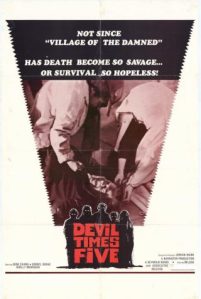 When setting out to watch this ’70s obscurity, I had no idea the sort of sleazefest I’d be enjoying. In one especially enlightening sequence, a bored and oversexed housewife emulates Of Mice and Men with the mentally challenged handyman, after which she is confronted by her daughter-in-law – the current paramour of an ex-conquest – and a breasts-exposing catfight ensues. The daughter-in-law subsequently goes to bed with the disputed boyfriend. Meanwhile, the other adult female on the premises is drinking heavily and badgering her shlump of a husband, played by Sorrell Booke. As this is happening, five deranged children who have survived a bus accident break into the secluded lodge-style home in which all of the above are weekending, and beat to death their pursuant erstwhile handler – in slow motion. This movie becomes quite unsettling as it unspools … but its creepiest component lies behind the scenes. Mid-seventies flash in the pan Leif Garrett plays one of the murderous kids (“Charlie”), as does his younger sister Dawn Lyn (“Moe”), and their mother (Carolyn Stellar) plays the sexpot, “Lovely,” who eventually is killed off, topless in the bath, by Moe. Hollywood family values – now that’s chilling.
 One of the more perverse films you’re ever likely to see outside of niche porn, this notorious Greek exploitation picture revels in sadistic glee – often focusing directly upon said glee on the protagonists’ faces. One can only wonder the distasteful levels director (Nico) Mastorakis could have reached had this film been lensed in modern times. As it is, however, more than a few of the catalogue of murders depicted here may be somewhat difficult to stomach – literally, in the instance of the victim forced to drink paint. Honestly, as the perpetrators’ acts escalate, it sometimes feels as if the director had a list of moral or criminal offenses that he wanted to portray. [Editorial note: I just found this on IoD‘s official website: “After listing the most depraved sexual acts he could conceive, Mastorakis wrote the script in a week.”] The movie does have a working framework, however, along with an admittedly dark sense of humor, and never relents. All told, an accomplished feature debut. (Being reviled internationally IS an accomplishment.)
 With all the makings of a cult classic, it’s a shame that this plodding soap opera can’t deliver the horror equivalent of, say, Reefer Madness. It does have a dippy drug subplot, though. This turgid melodrama also is in possession of outlandish, dated dialogue that probably felt just as forced and inauthentic then as now, along with a Californian Korean War vet with a British accent and an incestuous relationship, a runaway hippie chick, an Afro-sporting reporter for an underground newspaper called Young People’s Press, a steadfast law ‘n’ order sheriff and his deputies, an aging stripper and a death scene featuring a meat cleaver. Oh, and presumable cannibalism. Despite such an enviable list, this curio fails to keep one’s attention for long. One surmises it may have been intended to Make a Statement about Issues of the Day. The tearjerker ending is unexpected.
 FINALLY, a movie that will permit me to use the term “amanuensis” correctly. One that is basically a softcore flick with a few dodgy killings thrown in the mix, along with some largely meaningless flashbacks. Linda Hayden plays Linda Hindstatt, the amanuensis to a bestselling author, and it seems somebody has some shady secrets, or something. (Also, sex.) Various characters get “murdered” by a knife slashing at the camera or eliminated via shotgun; neither method is convincing. This potboiler was nearing its portentous conclusion by the time I realized the amanuensis was being portrayed by the very same actress who appeared as the naked teenage consort of the demon in The Blood on Satan’s Claw – which I probably shoulda realized sooner – so that was pretty exciting. The ending of this picture is not only a letdown and a cop-out, but uncreditable for various reasons, not the least of which being the immediately preceding action.
 Remember how you lived in fear of those kids at your high school who went, uh, hang gliding? You know – the ones who pushed everyone around and trashed the library. Oh, and tried to rape those weird hippie girls, and so forth. (Boy, that one kid had the grooviest custom van, though, didn’t he.) It was just such a shame about the poor kid, and the deaf one, and the fat one. Well, turns out what your school needed was a good allegory, as this excellent teensploitation film proves. A precursor to other films – scenes and characters herein must have served as inspiration for such celluloid classics as Heathers – and a predictor of symptoms of cultural decline (a kid in a TRENCH COAT perpetrates most of the mayhem in the latter half ), this production never fails to entertain. You may wonder how that’s possible at times, much as you may find the motivation of a few of the characters inscrutable, but ridiculous or not, it’ll hold your attention. Possibly its metaphorical qualities deserve the credit.
  SPACE RATS From Outer Space