directed by michael dugan
western international pictures
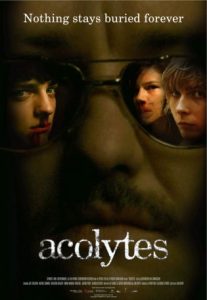
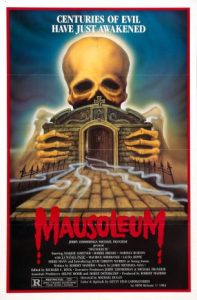 Wow, to say this is not what I was expecting from this movie might be the understatement of the year, at least in terms of this blog and its content. And while you’d think it would be hard for a horror flick to go wrong with demonic possession, this one manages to do so, repeatedly. No, it’s not without its charms – it’s so relentlessly absurd that it’s actually quite enjoyable, though presumably not as intentioned. Terminally silly, with a wafer-thin plot, Wikipedia claims this movie was granted a “special jury prize” by a Paris film festival, which as near as I can tell appears to be some completely fabricated bullshit. I will grant that the solution/cure for the demonic possession in this story is rather original.
Given the ludicrous FX  and its overall tasteless nature, I could see this one being a “cult classic,” presuming anyone would ever want to watch it more than once.
why did i watch this movie?
Do I gotta say it again? I keep thinking there’s this clutch of films out there where characters gotta spend the night in a MAUSOLEUM or some such, and –
should you watch this movie?
You look like you could use a good laugh.

And don’t much value your time.
highlight and low point
An utter lack of shame and limitless pandering are more or less the selling points here, though if you can figure out how or why the MAUSOLEUM becomes critical to this picture in the first place, you’re doing more work than Roberts Barich and Madero did when they wrote it. My favorite detail in this production is that the wallpaper and curtains in the psychiatrist‘s office match – and they’re a galling beige plaid.

It’s quite an effect.
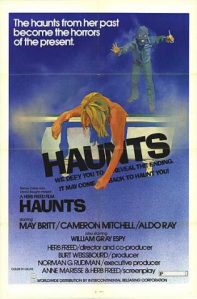 An oddity, this number is mostly a small-town slice-of-life crime thriller until its misleading, byzantine conclusion. Apparently issued on DVD without restoration, it looks terrible, and I was amused to find out its washed-out palette was allegedly purposeful. Aldo Ray as the sheriff is believable in his role, but anything else that’s noteworthy here merely relates to the presentation of a time and a way of life that are both long gone. Its weary, lived-in 1970s feeling kept it interesting for longer than was probably warranted. By the time the goings-on start getting sorted out, they get tangled up again, and you will have lost your patience by this point, particularly with the main character. She’s being stalked! Or maybe she isn’t. The local Casanova is a rapist, perhaps worse! Or IS he. “Better not book him just yet, we got the killer cornered down at the sawmill,” one character telephones. But what of the local parson, the uncle, the goat? The ending, like much of the rest, is a muddle.
 As this oddly delayed sequel began – a decade after the first installment – I confess, I really, really wanted to bag on it; the onset is not promising and it appeared as though it would be a cliché-ridden parade of stock characters and situations. Credit where it’s due, however – this film delivers exactly what it’s supposed to deliver, and it does it well. Not overly saddled with any particular panache, and devoid of much in the way of creativity beyond the overall “Strangers” framework, it’s still adept at ratcheting up the tension and producing effectively understated frights. Wisely, the palette is opened up a bit from the original, as the characters are not confined to one specific place, and although some of what could be termed “character development” verges on slasher-film shtick, it remains essentially rooted in realism. It IS a bit meta, however, occasionally evoking the line productions of the post-Scream era, and perhaps a bit predictable when it morphs into a revenge picture for a while. All told, a few groans don’t detract much. No classic, but it will entertain you well enough.
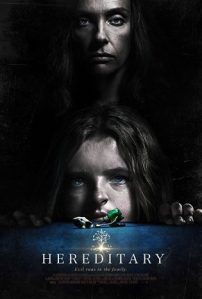 Another first-time feature director, Aster turns in an assured, forceful debut with this atmospheric creepshow. The pace is measured and the plot unfolds slowly, along the way doling out seemingly offhand tidbits that to this viewer were frankly hilarious at times. (It is hard to say whether any humor was intended.) The story keeps one’s attention, though for the first half or so that is often a byproduct of the fact that it is difficult to suss out precisely what is afoot. Once the second half gets going, it’s more compulsive. A set piece here or there dips into the tried-and-true, flirting with trite, but such engagement mainly serves to reinforce a vague feeling of nostalgia – although it is also true that on occasion a nagging sense of déjà vu may prevail. Never too viscerally frightening, what the proceedings suggest will linger long enough to give one a pretty good case of the heebie-jeebies … as long as certain plot points aren’t given too much thought, of course. Often redolent of a David Lynch film.
 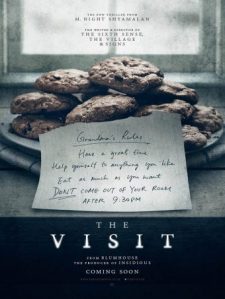 I can’t judge a movie based on the marketplace opinion of its creator, especially when I’ve only seen one of his other movies (The Sixth Sense), so all I can say about The Visit is what I thought: It works. Quite well, in fact. Granted, the setup of the story is a bit questionable, and as that’s the only reason the developments that follow make any sense whatsoever, it invites a quibble. The SHOCKING twist is very effective, however, and the children are extremely believable in their performances, and the moments where it might be reasonable to entertain serious doubts about the enterprise are explained away with just the right dubious touch. True, it lacks for visceral thrills and seems more of a mild mystery for the bulk of its running time – when it doesn’t play like an out-and-out comedy, that is. Perhaps that abets the impact of the final punchline. Fun for the whole family!
 All right, now this is more like it. This flick is completely nuts, sort of a lower-budget X Files set in the rural hinterlands, homemade recreational drug territory. Featuring flashbacks, hallucinations, drugs real and invented, the military, prostitution, mutations, questionable pregnancies, abductions, untrustworthy acquaintances, bad decisions, shady characters and probably some other stuff, the plot takes a loooong time to gain any coherence, and when Meg Tilly’s loonybin character shows up to try to clue in our protagonist, naturally she is disbelieved. The film justifies itself after a fashion, in what is not a sympathetic manner but is definitely a memorable one. Truth be told, Antibirth is kind of a mess and could have helped itself by cleaning up a few discursions or extraneous characters. Overall, however, it manages to be both funny and nauseating, and is generally well-written and acted, usually avoiding cliché despite itself. Its surrealism probably aids it in that regard.
 Now here we have a bona fide black comedy. This is a dark, dark picture, but it is laced throughout with unmistakable pathos, and the escalation of terrible miseries suffered by the eponymous character produces a kind of shell-shocked humor. Certainly, very little in this movie is funny per se, but it lurches enough toward the absurd to make it matter. It would be hard to definitively describe this as a horror film, but in all honesty, I’m not sure what else it could be called, either, given the internally logical extreme it eventually reaches. Carried not only by its madcap premise – May has trouble making friends, let’s say – but by the outstanding title performance from Angela Bettis, it’s an engaging accomplishment. Which is not to say it’s for everyone. In fact, a sequence or two in the latter half had me watching from between my fingers, and I seek out movies like this on purpose. But it manages to tug at the heartstrings in between blows to the head, and even the hokey (and ultimately predictable) final scene couldn’t besmirch it too much. I can see why this was a critical success.
 The story of three Troubled Teens – well, two of ’em, at least – who become enmeshed in a blackmail-and-murder triangle of sorts, this accomplished Australian venture turns progressively darker as it proceeds … and it starts off with a jarring, unpleasant scene. Every bit of the story seems to provide more psychological drama, which propels the narrative. The viewer is lured in further and further as the truths are revealed only bit by bit, and with a certain amount of misdirection, to boot. One of the SHOCKING twists in this one – there are several – actually is shocking, and another comes as a fairly big surprise as well. Unexpectedly good, this film succeeds largely through its portrayals of the teenagers; their complicated relationships with each other feel as though they are rendered accurately. The multifarious bait-and-switch maneuvers deftly executed by this production carry the day, however.
 Oh, man! In an earlier review I made a crack about Cannon Films, the purveyors of all sorts of cinematic treasures, and this masterpiece is from that very production studio’s defining era, when it was helmed by Menahem Golan and Yoram Globus! Imagine my delight! All right, I’ll settle down. This film, however, does possess all the hallmarks of its progenitors’ stable. It’s got replacement-level actors, including the tastefully named “Kip Niven” and the woman who played Pinky Tuscadero on Happy Days (Roz Kelly, for you trivia buffs). It also contains hilarious attempts at portraying contemporary culture, in this case “punk” and “new wave” bands and fans. (Ah, 1980.) The soundtrack alone almost defies description, particularly the title track, which possibly could sound less like “new wave” in the same manner that a jelly doughnut possibly could work less like a hammer. New Year’s Evil does, however, include one reasonably successful rendition of the SHOCKING twist – out of two, the second one being fairly predictable. A good time all around, fun for the whole family! Not really much of a horror movie in any way!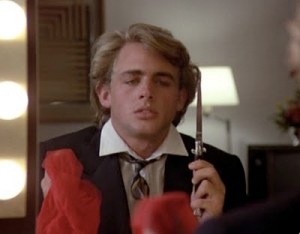
 SPACE RATS From Outer Space