directed by john mccauley
channel one productions
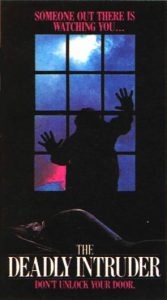 By almost any reasonable measure, this straight-to-video extravaganza isn’t any good. And yet it manages to project a kooky kind of charm, possibly because some aspects of it are just so … off. Unlike some of the other bad films I’ve denigrated herein, the filmmakers involved in this venture seem to have known what they were doing, but just do not appear to have been very proficient. Take the editing: the cuts interspersing glimpses of the characters’ domestic lives with the mounting terror, etc., are so ham-handed it’s jarring. The dialogue, meanwhile, continually interjects minutiae into random conversations. And then there’s the music, which at a certain point reaches a kind of lunatic insistence that is sorta breathtaking. On top of all that, the SHOCKING twist almost could work, but for anyone who for some reason is paying careful attention, one line rings a few too many bells, even with the painstaking misdirection involved. Classic ending, too. Oh, and one extremely minor character disappears during the climax, never again to be glimpsed or mentioned.
why did i watch this movie?
I could not ignore the creative and descriptive title.
should you watch this movie?
Probably not on purpose, but it is a good way to contemplate the Platonic ideal of straight-to-video.
highlight and low point
I really don’t want to ruin the fun for anyone who might theoretically watch this, but the scene in which an assailant takes his victim on a picnic obviously is unparalleled in cinematic history. The blatantly obvious use of a body double in the nude bathing scene is also top-notch. An early scene in a “police station” that is a glorious example of why-bother set dressing features an extended, juvenile scatology gag.
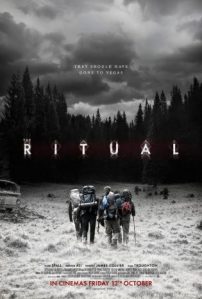 I suppose I can understand the urge some filmmakers get to adapt scary novels into (allegedly) scary movies. But since this compulsion has failed so many times and produced so many risible examples of lousy cinema, it becomes a lot more difficult to understand why some choose the projects they do. Such as, oh, I don’t know, The Ritual. Adapted from a taut, tension-filled book by Adam Nevill that describes a series of psychological ordeals, onscreen this Norse saga becomes a generic monster movie stuffed full of timeworn gestures and set pieces. (And filmed not in Scandinavia but Romania, which amuses me no end.) Often too rushed to develop any of its themes enough to produce any impact, details from the source text are tweaked, omitted or altered with varying degrees of success. A puzzling recurring theme that is wholly the movie’s invention is an error, however, and although the second movement of Nevill’s story isn’t any great shakes, what it becomes on film is not only completely different but far less useful or comprehensible, its intended climactic finale instead ridiculous and nonsensical. Perhaps I shouldn’t have read the novel first.
 FINALLY, a movie that will permit me to use the term “amanuensis” correctly. One that is basically a softcore flick with a few dodgy killings thrown in the mix, along with some largely meaningless flashbacks. Linda Hayden plays Linda Hindstatt, the amanuensis to a bestselling author, and it seems somebody has some shady secrets, or something. (Also, sex.) Various characters get “murdered” by a knife slashing at the camera or eliminated via shotgun; neither method is convincing. This potboiler was nearing its portentous conclusion by the time I realized the amanuensis was being portrayed by the very same actress who appeared as the naked teenage consort of the demon in The Blood on Satan’s Claw – which I probably shoulda realized sooner – so that was pretty exciting. The ending of this picture is not only a letdown and a cop-out, but uncreditable for various reasons, not the least of which being the immediately preceding action.
 Yikes. Given this dreck, your intrepid movie guide is almost inclined to reconsider his grades for some of the other terrible films in this compendium, because this disaster is so awful that it makes duds such as Blood Harvest and Island of Blood seem like minor missteps. This stinker comes across like the result of an experiment: take components one normally associates with horror movies, blindfold somebody, and have him, her or it try to assemble said parts into a coherent whole. Hint: It “helps” if the actors cannot act, the vast stretches filmed in darkness are unlit or poorly lit – a “technique” one may remember fondly from “Scared Alive” – and the so-called “script” … may or may not exist. (Sample: Character leaves house, gets killed. Repeat with next character. ) Speaking of things that may or may not exist, this putrid mess has an honest-to-Pete score that disappears for much of the second half, making me wonder if the filmmakers forgot about it along with pacing, continuity, editing and cinematography. Body By Jake is the inexcusably aggravating PCP-addled killer in this terrible waste of time, and wow, I haven’t even mentioned the (presumably) KISS-inspired character appropriately named “The Mistake.” An embarrassment.
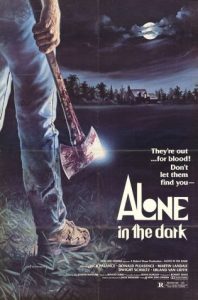 Sometimes, I watch a movie and I just wonder how it ended up exactly the way it did. Take this flighty little number: It plays essentially like a PG-rated family comedy, but it also includes some vaguely gory killings, flashes of nudity, a mislocated but frightening hallucination, and, unexpectedly, the band Sic F*cks. And Jack Palance, and Martin Landau, gleefully overacting as two deranged asylum escapees. Fans of the original NBC-TV series The A-Team will be glad to see “Howlin’ Mad” Murdock as the patriarch of the family in peril, and general film aficionados possibly will enjoy Donald Pleasence’s turn as the loopy, stoned head of the psychiatric institution turned porous by a power outage. Amusingly, the family never actually seems to be in the dark, thanks to the marvels of movie lighting. (Hardly anyone’s alone at any point, either.) Overall, a strangely effervescent experience given the subject matter.
 Remember how you lived in fear of those kids at your high school who went, uh, hang gliding? You know – the ones who pushed everyone around and trashed the library. Oh, and tried to rape those weird hippie girls, and so forth. (Boy, that one kid had the grooviest custom van, though, didn’t he.) It was just such a shame about the poor kid, and the deaf one, and the fat one. Well, turns out what your school needed was a good allegory, as this excellent teensploitation film proves. A precursor to other films – scenes and characters herein must have served as inspiration for such celluloid classics as Heathers – and a predictor of symptoms of cultural decline (a kid in a TRENCH COAT perpetrates most of the mayhem in the latter half ), this production never fails to entertain. You may wonder how that’s possible at times, much as you may find the motivation of a few of the characters inscrutable, but ridiculous or not, it’ll hold your attention. Possibly its metaphorical qualities deserve the credit.
  Oh hey look, it’s an anthology film! You love those! The hook here is that all four segments are by female directors, and mainly are written by them as well. (The first is based on a story by our old pal Jack Ketchum.) If you are a familiar of the horror anthology film and have seen any of the roughly 2,000 or so that have been churned out over the past handful of years, you no doubt are well aware they are governed strictly by the law of diminishing returns. This one is no different. Of the four chapters, one is effective if burdened by a creaky concept (“The Box”); one is ridiculously derivative of stories in several other anthologies I can think of without much difficulty (“Don’t Fall”); another also sadly lacks in originality and calls to mind analogues in recent compilation films (“Her Only Living Son”); and one is pretty amusing if somewhat predictable (“The Birthday Party”). Each portion is introduced by
  After watching this feature, I think I can better understand the opprobrium I’ve often seen hurled at its director in discussions of his oeuvre. Not that this is a bad movie, mind you; it does what it does fairly well, but it has a … credibility issue. I mean, I found myself not buying the central premise. At all. Don’t get me wrong; I am not denying the possibility of traumatic onset of multiple personalities, or dissociative identity disorder. The theory involved in this picture, however, takes pseudoscience directly into the realm of the comic book, in my professional opinion. (Disclaimer: I am not a doctor.) Furthermore, I usually am not seeking stories concerning supernatural physical characteristics or characterizations, such as found in superhero or -villain flicks. In addition, I found the scant inserts providing backstory to be both clumsy and stereotyped. THEN it turns out it’s somehow part of a trilogy-of-sorts – or a tripartite narrative, maybe. And it’s also a little too long, if only because it gave me time to realize all this.
 A movie with a well-nigh perfect setup for a drive-in, this throwback-styled picture concerns a woman who kills a guy in a motel room and calls her estranged husband for help, after which they become targets of a murder cult. See? That’s a hard premise to best, and while director Keating’s effort doesn’t quite deliver – there isn’t as much disturbing content as might be expected, nor as much emotional impact; some of the imagery is pretty cheesy and some sequences feel like no more than padding – it’s an impressive enough attempt that I almost immediately sought out a few more films with his stamp. (Those being Darling and Pod, which I’ll get to in due time.) As I’ve hinted before, a sliding scale is employed here, and Ritual is the right kind of endeavor in my book. You can’t fail if you don’t try, people. Trust me on that one.
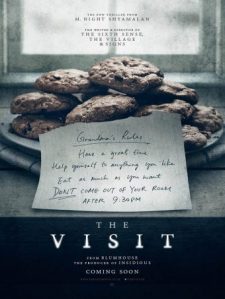 I can’t judge a movie based on the marketplace opinion of its creator, especially when I’ve only seen one of his other movies (The Sixth Sense), so all I can say about The Visit is what I thought: It works. Quite well, in fact. Granted, the setup of the story is a bit questionable, and as that’s the only reason the developments that follow make any sense whatsoever, it invites a quibble. The SHOCKING twist is very effective, however, and the children are extremely believable in their performances, and the moments where it might be reasonable to entertain serious doubts about the enterprise are explained away with just the right dubious touch. True, it lacks for visceral thrills and seems more of a mild mystery for the bulk of its running time – when it doesn’t play like an out-and-out comedy, that is. Perhaps that abets the impact of the final punchline. Fun for the whole family!
 SPACE RATS From Outer Space