directed by lucky mckee
United artists/cinerenta/furst films/cinegreen
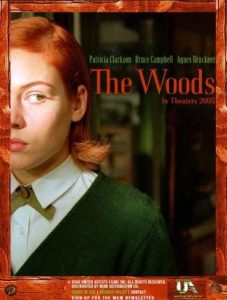 I am not altogether certain that this flick accurately portrays some of the nuances of its setting, that being 1965 New England. For that matter, I do not know why this flick is set in 1965 – or what, really, was its intention. A meandering and not particularly interesting tale of presumably ancient witchcraft involving – you’ll never guess – the forest surrounding a peculiar school for girls, this film helmed by Lucky McKee plays out like just another teen-drama conflict, with Problems With Authority to boot. Following a main character named “Heather,” which is probably not a coincidence, and overplaying the mysterious and potentially threatening nature of certain faculty members, it never becomes too frightening and doesn’t provide nearly as much intrigue as was probably intended. Part of the problem may be that there’s a whole lotta nothin’ where the story’s supposed to be. Several clumsy subplots and possible false flags don’t help, and neither does the CGI. A completely unremarkable movie that even manages to waste a rare underplayed appearance by Bruce Campbell.
why did i watch this movie?
The other McKee pictures I’ve watched were good, and reviews of this one were largely positive. (Personally, I didn’t think it sounded all that interesting, however.)
should you watch this movie?
If you feel like watching something and don’t much care what it is, it’ll fit the bill, as it doesn’t seem to care much, either.
highlight and low point
Too hackneyed and constructed by half-measures to supply any memorable peaks, this movie also boasts an anticlimax that is markedly weak.
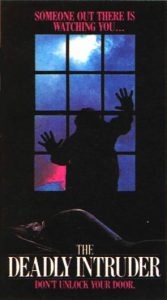 By almost any reasonable measure, this straight-to-video extravaganza isn’t any good. And yet it manages to project a kooky kind of charm, possibly because some aspects of it are just so … off. Unlike some of the other bad films I’ve denigrated herein, the filmmakers involved in this venture seem to have known what they were doing, but just do not appear to have been very proficient. Take the editing: the cuts interspersing glimpses of the characters’ domestic lives with the mounting terror, etc., are so ham-handed it’s jarring. The dialogue, meanwhile, continually interjects minutiae into random conversations. And then there’s the music, which at a certain point reaches a kind of lunatic insistence that is sorta breathtaking. On top of all that, the SHOCKING twist almost could work, but for anyone who for some reason is paying careful attention, one line rings a few too many bells, even with the painstaking misdirection involved. Classic ending, too. Oh, and one extremely minor character disappears during the climax, never again to be glimpsed or mentioned.
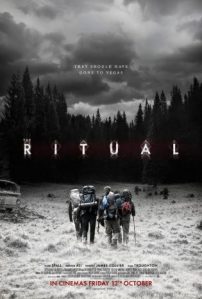 I suppose I can understand the urge some filmmakers get to adapt scary novels into (allegedly) scary movies. But since this compulsion has failed so many times and produced so many risible examples of lousy cinema, it becomes a lot more difficult to understand why some choose the projects they do. Such as, oh, I don’t know, The Ritual. Adapted from a taut, tension-filled book by Adam Nevill that describes a series of psychological ordeals, onscreen this Norse saga becomes a generic monster movie stuffed full of timeworn gestures and set pieces. (And filmed not in Scandinavia but Romania, which amuses me no end.) Often too rushed to develop any of its themes enough to produce any impact, details from the source text are tweaked, omitted or altered with varying degrees of success. A puzzling recurring theme that is wholly the movie’s invention is an error, however, and although the second movement of Nevill’s story isn’t any great shakes, what it becomes on film is not only completely different but far less useful or comprehensible, its intended climactic finale instead ridiculous and nonsensical. Perhaps I shouldn’t have read the novel first.
 FINALLY, a movie that will permit me to use the term “amanuensis” correctly. One that is basically a softcore flick with a few dodgy killings thrown in the mix, along with some largely meaningless flashbacks. Linda Hayden plays Linda Hindstatt, the amanuensis to a bestselling author, and it seems somebody has some shady secrets, or something. (Also, sex.) Various characters get “murdered” by a knife slashing at the camera or eliminated via shotgun; neither method is convincing. This potboiler was nearing its portentous conclusion by the time I realized the amanuensis was being portrayed by the very same actress who appeared as the naked teenage consort of the demon in The Blood on Satan’s Claw – which I probably shoulda realized sooner – so that was pretty exciting. The ending of this picture is not only a letdown and a cop-out, but uncreditable for various reasons, not the least of which being the immediately preceding action.
 Yikes. Given this dreck, your intrepid movie guide is almost inclined to reconsider his grades for some of the other terrible films in this compendium, because this disaster is so awful that it makes duds such as Blood Harvest and Island of Blood seem like minor missteps. This stinker comes across like the result of an experiment: take components one normally associates with horror movies, blindfold somebody, and have him, her or it try to assemble said parts into a coherent whole. Hint: It “helps” if the actors cannot act, the vast stretches filmed in darkness are unlit or poorly lit – a “technique” one may remember fondly from “Scared Alive” – and the so-called “script” … may or may not exist. (Sample: Character leaves house, gets killed. Repeat with next character. ) Speaking of things that may or may not exist, this putrid mess has an honest-to-Pete score that disappears for much of the second half, making me wonder if the filmmakers forgot about it along with pacing, continuity, editing and cinematography. Body By Jake is the inexcusably aggravating PCP-addled killer in this terrible waste of time, and wow, I haven’t even mentioned the (presumably) KISS-inspired character appropriately named “The Mistake.” An embarrassment.
 A movie with a well-nigh perfect setup for a drive-in, this throwback-styled picture concerns a woman who kills a guy in a motel room and calls her estranged husband for help, after which they become targets of a murder cult. See? That’s a hard premise to best, and while director Keating’s effort doesn’t quite deliver – there isn’t as much disturbing content as might be expected, nor as much emotional impact; some of the imagery is pretty cheesy and some sequences feel like no more than padding – it’s an impressive enough attempt that I almost immediately sought out a few more films with his stamp. (Those being Darling and Pod, which I’ll get to in due time.) As I’ve hinted before, a sliding scale is employed here, and Ritual is the right kind of endeavor in my book. You can’t fail if you don’t try, people. Trust me on that one.
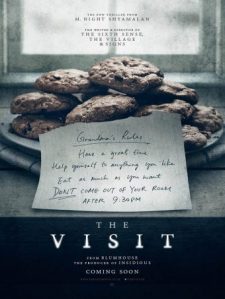 I can’t judge a movie based on the marketplace opinion of its creator, especially when I’ve only seen one of his other movies (The Sixth Sense), so all I can say about The Visit is what I thought: It works. Quite well, in fact. Granted, the setup of the story is a bit questionable, and as that’s the only reason the developments that follow make any sense whatsoever, it invites a quibble. The SHOCKING twist is very effective, however, and the children are extremely believable in their performances, and the moments where it might be reasonable to entertain serious doubts about the enterprise are explained away with just the right dubious touch. True, it lacks for visceral thrills and seems more of a mild mystery for the bulk of its running time – when it doesn’t play like an out-and-out comedy, that is. Perhaps that abets the impact of the final punchline. Fun for the whole family!
 All right, now this is more like it. This flick is completely nuts, sort of a lower-budget X Files set in the rural hinterlands, homemade recreational drug territory. Featuring flashbacks, hallucinations, drugs real and invented, the military, prostitution, mutations, questionable pregnancies, abductions, untrustworthy acquaintances, bad decisions, shady characters and probably some other stuff, the plot takes a loooong time to gain any coherence, and when Meg Tilly’s loonybin character shows up to try to clue in our protagonist, naturally she is disbelieved. The film justifies itself after a fashion, in what is not a sympathetic manner but is definitely a memorable one. Truth be told, Antibirth is kind of a mess and could have helped itself by cleaning up a few discursions or extraneous characters. Overall, however, it manages to be both funny and nauseating, and is generally well-written and acted, usually avoiding cliché despite itself. Its surrealism probably aids it in that regard.
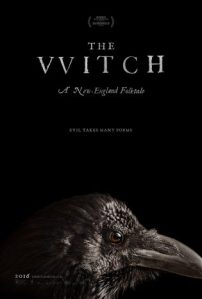 The first time I tried to watch this film, I stopped after about 10 minutes, as it started off with what at the time seemed to be a hokey attempt at a period setting, in this case early 1600s New England. I kept seeing rave reviews for it, however, so I gave it another go. Turns out it was nothing that I had expected. Sure, it’s got the rustic isolation and the religious underpinning, but it focuses almost entirely on just one family, alone at the edge of the woods. Things proceed slowly for a while, with only some parent-child tension and sibling rivalries raising suspicion, but once the action begins, I had to hang on to my hat, figuratively speaking. Still, for most of the picture, it’s a fairly standard affair – so much so that before the final act or so begins, I was preparing to write it off entirely. That final act, however, earns the proceedings a different perspective by taking things to an unforeseen level. (One detail in particular surprised me.) Not perfect, and in places banal, but not bad at all for the first-time director.
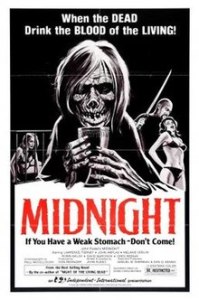 This delight’s got a little bit of everything. It’s got a weird Satanist family cult, it’s got a teenage runaway from Troubles At Home, it’s got Lawrence Tierney, it’s got a road-trip film contained within it, it’s of a visual quality usually associated with home movies from the dawn of time, and it’s got a fabulous theme song that is completely out of place in its grim milieu and sounds as though it’s from the wrong decade besides. Midnight is also strangely paced and edited, and could be a Christian message movie in disguise. Let’s see, what else … travel montages, black characters that seem as misplaced as the title song, a blatant ripoff of Psycho, and an extremely abrupt and unlikely ending involving rescue, redemption and revenge. Oh, and more of the rebarbative laughter à la the goons from Death Weekend. All told, an entertaining exploitation picture – and based on a novel! Which I cannot WAIT to read. The auteur was a colleague of George Romero.
 SPACE RATS From Outer Space