directed by norman j. warren
tymar film productions limited
 I’ll admit it, I enjoy it a little too much – trotting out the jejune sally that “the REAL horror here is blah blah blah” and so forth – but dig it, man, that foolishness is perfectly suitable for this bonkers English presentation. Oh, don’t get me wrong, this film is for the most part shoddy and boring, but holy cats does it contain some absolutely bizarre goings-on. For one thing, it’s only around 84 minutes long, but it manages to contain a four-minute-plus lesbian scene that is frankly a lot more explicit than I would’ve supposed. For another thing, at a certain point – for no discernible reason – everything goes slo-mo as the soundtrack suddenly becomes extremely psychedelic and discordant. And no kidding, even though the story concerns a space alien who’s on Earth scouting for new “protein sources” (“spoiler”!), heavens to Murgatroyd but that isn’t the REAL horror here. I watched the climactic action of this picture jaws literally agape.
why did i watch this movie?
This is the film Mr. Warren made right after the widely acclaimed cerebral exercise Satan’s Slave.
should you watch this movie?
I don’t think I really have an answer for that question. You’re on your own.
highlight and low point
The makeup and/or “FX” are, uh, minimally invasive, shall we say.

But seriously, one thing I did find laudable about this very strange flick is that it contains all of six actors. This film’s shortcomings are not a result of its minimal casting or financing, though the latter probably doesn’t help. ’Tis a pity they never made the sequel. ’Tis also a pity some critics have identified all sorts of subtextual sociological signifiers that were almost certainly tangential to this preposterous undertaking. Sure, sure, I get it, “microaggressions,” I hear ya. [Backs away]
rating from outer space: C−
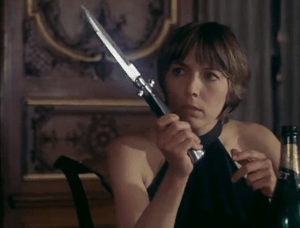
that’s a switchblade, would you believe
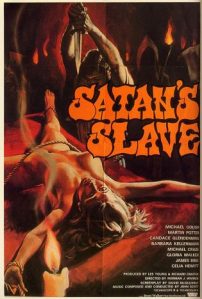 Oh, Satan’s Slave, where have you been all my life? Sure, I’ve recently watched a movie with that

 Well now, THIS is an unpleasant little flick. I mean, nothing in this picture is going to make a viewer feel very good, unless that viewer has got some serious issues. A few things may make the viewer laugh, sure, but this is a movie that is based around psychological problems brought about by severe child abuse, which it is suggested is itself a manifestation of psychological and/or emotional disability, and which itself is manifested in cruel, ugly, sadistic, misogynistic murder. (If you doubt that description, it involves a special room clad in stainless steel.) Oh, and extreme social dysfunction is added in just for kicks. On the upside, it’s got a disco theme underlying everything, and hallucinated ambulant corpses. Effectively dismal, better than I expected, and a reminder of how much I generally seem to enjoy films from this hopeless and beaten-down time period.
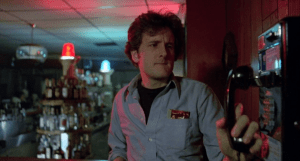 as I thought Donny the murderous lunatic’s social awkwardness was portrayed brilliantly. In fact, I generally enjoyed Bobby’s presence throughout the proceedings,
 though I remain baffled by the fact that when he believes Donny is in danger, he fetches local parson Father Gerrity and not, you know, the police.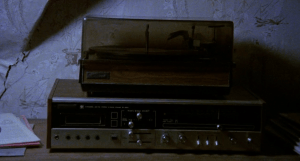
 You know, I enjoy listing the multiple titles for some of these pix, mainly because it usually follows that the more different names a film acquires throughout its life of distribution, the more debatable its quality. There are exceptions, of course; every rule has them. This picture could be one of those exceptions. Its sobriquet may have been appended because somebody wisely decided that the original name didn’t make any sense whatsoever. Now, ’tis true that one of the characters in this patently Deliverance-derived flick makes an offhand remark – a barely audible offhand remark, mind you – that the subjects may be the victims of a demonic
 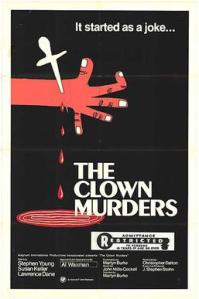 Based around a rather dubious proposition – kidnapping an acquaintance’s wife to prevent him from making a business deal at, uh, the stroke of midnight, or something along those lines – the REAL horror here is in the breakdown of the characters’ shared relationships, man. Oh, and in the revelation of the ugly truths underlying their established personas. Or something along those lines. Only intermittently interesting for some of the glimpses at the dynamics of the power structure within this group of former school chums, events eventually take a dramatic and unexpected turn for the somewhat perverse once the action tips toward and past the climax. (Literally! In at least one sense.) It’s not too hard to figure out the mystery-of-sorts as regards the killer clown(s), but another mystery proves more elusive: what the hell?
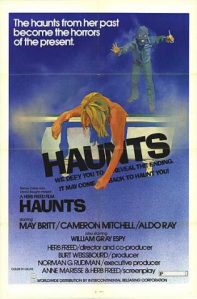 An oddity, this number is mostly a small-town slice-of-life crime thriller until its misleading, byzantine conclusion. Apparently issued on DVD without restoration, it looks terrible, and I was amused to find out its washed-out palette was allegedly purposeful. Aldo Ray as the sheriff is believable in his role, but anything else that’s noteworthy here merely relates to the presentation of a time and a way of life that are both long gone. Its weary, lived-in 1970s feeling kept it interesting for longer than was probably warranted. By the time the goings-on start getting sorted out, they get tangled up again, and you will have lost your patience by this point, particularly with the main character. She’s being stalked! Or maybe she isn’t. The local Casanova is a rapist, perhaps worse! Or IS he. “Better not book him just yet, we got the killer cornered down at the sawmill,” one character telephones. But what of the local parson, the uncle, the goat? The ending, like much of the rest, is a muddle.
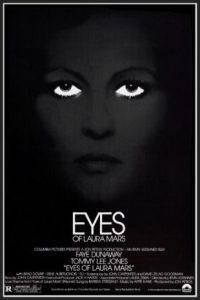 When it comes to mysteries, I’m the quintessential mark. It’s that character! No, that one! Wait, it’s probably her! Every time. How bad is it? I kept waffling about the probable identity of the killer whose dastardly exploits are viewed through Laura’s Eyes, even though this movie is 40 years old and I’ve read about it multiple times. Anyway, this production – written by John Carpenter for his first major film credit – knowingly manipulates its audience with suspenseful close-ups of René Auberjonois, our old pal Brad Dourif, the late Raúl Juliá, and other, less famous actors. Nonetheless, even a major misdirection in the late going doesn’t deter one from deducing the SHOCKING ending, especially as it’s telegraphed shortly beforehand. More “thriller” than “horror,” but it IS chock full o’ murders, death, and images thereof. The maudlin “Prisoner (Love Theme from Eyes of Laura Mars)” blares over the end credits, Barbra Streisand holding nothing back.
 This British film is absurdly amateurish, and in fact may be one of the most unprofessional movies made by an actual studio that you’re apt to see. It’s all here – ripoff script, the lowest of budgets, random illogic and execrable dramatics. Joan Collins isn’t even the worst actor in this picture, which should really tell you something. One of the characters is a nun, and her fake Italian accent is truly a wonder to behold, especially voicing dialogue such as “Is it possible for a baby not to want to be born?” The performances are so laughable that Donald Pleasence – DONALD PLEASENCE – appears reasonably accomplished with his typically disaffected mien. The absolutely most striking feature here, though, is that the director repetitiously focuses on an ordinary baby lying in its crib (or “pram,” depending on scenario) to illustrate … EVIL. Or something. It is, uh, not effective. Whatever you call this mess, it’s another abominable creation that later became a “camp classic” – although typically part of such (dis)honor is that dreck becomes enjoyable when you’re in on the joke, and this film is not enjoyable for any reason. (By the way, the baby’s mother’s name is Lucy; no Sharon can be found.)
 Now, this is more like it! A tremendously realized mid-’70s fright flick that succeeds without any of the earmarks that would soon begin to plague the genre (slashing, masks, teenagers, etc.), this mainly psychological horror picture draws one in the old-fashioned way. Something’s obviously wrong, seemingly minor issues continuously get more worrisome, the situation keeps deteriorating … but nothing too specific can be identified. (You’ll probably get an inkling, of course.) Tiny hints here and there tiptoe toward the devastating conclusion, and it’s all handled impeccably. Well, truth be told, things get a little out of hand as that ending nears, including some of the performances, but that neither lessens the impact nor diminishes the achievement. The film does almost overstay its welcome; it’s a minor flaw, though exacerbated a bit as the climax nears, as it feels as though substantial cuts must have been made. Oliver Reed is his usual intense self throughout, so that’s a hoot, Karen Black handles a complicated role fairly well, and Bette Davis is excellent.
 The first thing I noticed about this movie, the sophomore effort from Bob Clark following Children Shouldn’t Play With Dead Things, is how vastly improved in every aspect of filmmaking it is in comparison to that initial offering. Script, lighting, camerawork, acting, pacing, makeup effects – everything is better. It’s as though Clark and head writer Alan Ormsby made a serious study of their inaugural production in order to make a more professional showing with their next film. Whatever the explanation – the budget was almost 400% larger, nearly $240,000! – it worked, because altogether this little horror picture is nearly excellent. The emotional impact of the small-town boy returning from a foreign war and the many repercussions of his impaired condition – to describe it as benignly as possible – are powerfully depicted, and the creeping sense that something is very wrong is deftly developed. Inspired by the W. W. Jacobs story “The Monkey’s Paw,” this saga sure seems to have been bastardized within S. King’s 1983 novel Pet Sematary in the tale of Timmy Baterman. (PERHAPS coincidentally, late in this flick, the action veers into a graveyard identified on its iron gates by a sign bearing the misspelling “Cemetary.”)
 SPACE RATS From Outer Space