directed by bill naud
creative film makers/srn
 Apparently also known by the terribly baffling title Scared Alive, this is one baffling, terrible piece of filmmaking. Not only is the script lousy, and the acting, but it’s technically awful as well – a large portion of the movie takes place at night, in various dark locations, and is so poorly lit and filmed that it is often impossible to tell what is happening, or which characters are involved. At other times, it is also difficult to discern which characters are which for other reasons, leading to further confusion. During several onscreen conversations, I found myself wondering who the dialogue was referencing, being unable to place the name. (Since characters seemed to go unaccounted and reappear at random, this is perhaps not entirely my fault.) Probably not quite as bad as George Phblat’s infamous Benji Saves the Universe, but it’s gotta be close. The ridiculous murder-presaging song that plays incessantly throughout (it’s called “Face to Face”) is kinda catchy.
why did i watch this movie?
I will once again allow that I chose this particular film precisely because it sounded as though it could not possibly be any good at all. I have been honing this skill for many moons.
should you watch this movie?
“It’s really bad” is my final statement on that.
highlight and low point
The fact that a terrible movie features within it the making of a terrible movie might have been interesting had the creative geniuses behind the cameras the wherewithal to evince any self-awareness, but we’re plunging too far into the realm of the purely theoretical here. At least one of the murders is so preposterous and slapdash that one might reasonably suspect this whole affair to be a jape.
 Also known, in the United Kingdom at least, as Harpoon: Reykjavik Whale Watching Massacre – probably to distinguish it from all the other movies titled “Harpoon” or because “Reykjavik Whale Watching Massacre” wasn’t a descriptive enough title for a movie about a massacre that takes place during a whale-watching expedition in the waters around Iceland – RWWM is a odd little slice of bad tidings. It’s also funny, after a fashion; the term used could be “black humor” were it not quite so ill-mannered or misanthropic. Actually, one of the most interesting things about this exercise in callous, gratuitous cruelty is how the alleged humor is played – very offhandedly, for the most part. By this I mean there’s no setup and no reaction to any of the moments of presumable mirth; they’re just a part of the mélange. It’s quite an approach, and adds an appealing touch of cinéma vérité to a picture that probably doesn’t warrant it. Not as much of a feel-good film as one might expect from the uplifting title.
 Oh, man! In an earlier review I made a crack about Cannon Films, the purveyors of all sorts of cinematic treasures, and this masterpiece is from that very production studio’s defining era, when it was helmed by Menahem Golan and Yoram Globus! Imagine my delight! All right, I’ll settle down. This film, however, does possess all the hallmarks of its progenitors’ stable. It’s got replacement-level actors, including the tastefully named “Kip Niven” and the woman who played Pinky Tuscadero on Happy Days (Roz Kelly, for you trivia buffs). It also contains hilarious attempts at portraying contemporary culture, in this case “punk” and “new wave” bands and fans. (Ah, 1980.) The soundtrack alone almost defies description, particularly the title track, which possibly could sound less like “new wave” in the same manner that a jelly doughnut possibly could work less like a hammer. New Year’s Evil does, however, include one reasonably successful rendition of the SHOCKING twist – out of two, the second one being fairly predictable. A good time all around, fun for the whole family! Not really much of a horror movie in any way!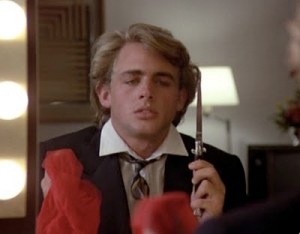
 The main thing I noticed in this peculiar low-budget pic is that almost all of the actors portraying college students are way too old; along with that factor comes the clumsy nature of the dialogue, somewhat common to B-movies trying to portray “realistic” campus life. Also evident is the off-brand quality of this production. Though a reasonable facsimile of a film a major studio may have made, the differences are definitely noticeable in set design and wardrobe, to name but a few departments. (Several of the performers also appear to be cut-rate imitations of Name Actors.) The coherence of the story – which is otherwise off-the-shelf tomfoolery – is similarly lacking, perhaps because it seems to be missing details that might have shed some light on various characters’ motivations. It is entirely possible I am putting too much thought into my analysis of this tale about some kinda demonic ritual pact. Oh, and the SHOCKING ending isn’t, of course.
 Short and inconsequential, this straight-to-video (and laserdisc!) offering is also kind of derivative, although there we go again … horror film, blab blah, &c. Not obviously reprising any particular movie – faint praise, perhaps, but it’s something – Dweller doesn’t seem sure what niche it wants to occupy. It’s not quite campy, not very funny or scary, and not nearly as outré as it seemingly wants to be. Jeffrey Combs has what amounts to a cameo setting up the action as a comic-book artist whose hideous creation comes to life, quite in keeping with his erstwhile cottage industry of acting in Lovecraftian roles. Also appearing for some reason: a cavalcade of onetime TV stars including those who played Lily Munster, Ben Casey and “Eric” from Head of the Class. One interesting thing this flick has going for it is its bummer ending, which seems especially odd in such an essentially lighthearted affair. Kinda not really worth it.
 More or less a Twilight Zone episode at feature length, this entertaining trifle never gets particularly scary, although a few of the death scenes certainly qualify as unpleasant enough. One might quibble that there’s an underlying plot hole for which it is particularly hard to suspend one’s disbelief – it of course involves the SHOCKING twist near the end, and I had been anticipating its revelation with mounting dismay for quite some time before it came to pass – but let’s face it, this is a horror movie, and demanding credibility could render the whole genre nonexistent. Outlandish characters are depicted with gusto and that old chestnut, the Small Town with a Secret, is given the right insider’s feel. The fact that the absurdist conclusion threatens to tip the scales to outright humor – if it doesn’t succeed, that is – doesn’t detract much from the overall effect. Fun, if not exactly crucial.
 Here’s a rarity for this list: a good movie. Actually good, that is, not “good for a horror movie,” not “good” (scare quotes) – a film that’s well-written, well-acted, well-directed … how the hell did this happen? I feel cheated. Not quite the supernatural assault suggested by the promotional artwork, this Australian feature is a rather more subtle affair centering around strange goings-on in the retirement home the main character has inherited following her mother’s death. These eldritch occurrences seem to have been foreshadowed by similar happenings related in her mother’s diary decades earlier. Are things not what they seem? How DO things seem? WHO can one trust, et cetera. This picture appears never to have had a domestic theatrical release, and the fine lead actress appears never to have had a further career. An understated, somewhat ethereal affair, its scares and the tension it creates are earned by never overplaying its hand and always retaining some rooting in reality. As I said, it’s a good one.
 Abel Ferrara’s non-pornographic feature-length directorial debut, in which he also stars under a pseudonym as the main character, a struggling-artist type in the Big City. With two female roommates – one of whom is apparently married and affluent, the other of which is, like, spaced out, man. (The roommates have a shower scene, because it’s very important to the plot.) Of the plot, it must be said, there is one: Reno, the artist, is working on a painting he hopes to sell to the gay art dealer he dislikes but nonetheless depends on, because Reno has no money. Meanwhile, a band called Roosters moves into his same tenement building and practices their discordant off-key blues-influenced new wave at all hours. Naturally, he starts killing derelicts with a power drill. Then things start to go awry. The best parts of this movie are the Roosters, whose music is chaotic and senseless and not “good,” and the utter zeal with which the drill killings are performed. Abel Ferrara: we need filmmakers like him.
 Wow, where to begin with this slice of cinematic … excellence. First off, it really comes across like an excessively long (and gory) episode of Police Squad! Lousy acting, ridiculous story, unbelievable characters … Pieces has got it all, and then some. (From Wikipedia, as written: “The film has retained a cult following however among bad movie fans on account of its numerous logical absurdities, gaffes, unlikely dialogue and ridiculous moments.”) From the opening scene on, nary a credible moment can be found. What is most difficult to believe, given the script and the circumstances of the production, is that the cast seems to be playing it completely straight. The apogee for this viewer is the “championship” tennis match between two women who play as though they had never held rackets before – which turns out not to be far from the truth. The SHOCKING postscript appended makes absolutely no sense whatsoever, but it sure should’ve led to an even more implausible sequel, with the added bonus of potentially being in an entirely different realm of horror. A sadly missed opportunity, in my opinion.
 Hahahahaha. Only tangentially a horror movie, this beaut is a “thriller” of the sort Cannon Films churned out for so many years, except without the finer qualities for which that studio was so widely admired. Set in “Mexico” (filmed largely in Venezuela), this cheerfully idiotic film is concerned with some sorta Entity of the ancient Mayan culture that … okay, the thing is, people are dying because – there’s this guy, see, he’s a, he’s a … archeologist? Anthropologist? Or is that the other guy, no, wait, that guy’s a folklore expert and a mystic, never mind. Anyway, the dead guy’s daughter comes down to, uh, okay, she … Let’s take stock: There’s the dead guy’s daughter, the gringo gambling man, his jealous local ex, the bar owner, unreliable locals, the planned ritual sacrifice of a village child – I’m probably forgetting some pertinent details – and finally, glowing eyes. Man, watch out for those glowing eyes. No, Doctor, I have no idea.
