DIRECTED BY HERSCHELL GORDON LEWIS
BOX OFFICE SPECTACULARS, INC.
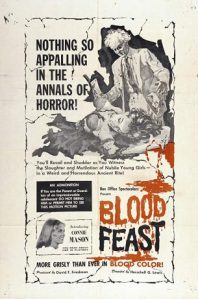 Here is where we should begin our disquisition on the ephemeral nature of what constitutes art vis-à-vis garbage, and engage in deep contemplation on the revealed substance and its relation to the Ideal, and how mere imitation or re-creation can only hope to further distance us from the knowledge of this state of perfection. We should, but we won’t, because gore impresario, auteur loon and marketing maven Herschell Gordon Lewis would probably laugh and point at us. His frankly ridiculous tale of catering a Society party with an “authentic Egyptian Feast” as a hopeful means of reviving the goddess Ishtar via cannibalism features some impossibly wooden acting, hilariously half-assed set dressing, excessively expository dialogue, indubitably fake blood, transparently ersatz makeup and FX, rudimentary cinematography, et cetera et cetera et cetera et cetera. (And in the midst of life we are in debt, et cetera.) Blows the doors off the insipid remake I panned a few weeks back, ably demonstrating the difference between a “bad” movie and the truly wretched.
WHY DID I WATCH THIS MOVIE?
Well, I watched the other one, didn’t I. You know, years back, I toiled at a mail-order company, the offbeat small-business-owner of which enjoyed visiting Lewis’s marketing website. He also enjoyed pointing out Lewis’s track record of proven “pull.”
SHOULD YOU WATCH THIS MOVIE?
It’s barely over an hour long!
HIGHLIGHT AND LOW POINT
It’s barely over an hou – yeah, just joshing, sorry. Scott H. Hall and Mal Arnold, as “police captain” and “Fuad Ramses,” respectively, suffice for shorthand. Hall is so terrible a thespian he shoulda been a “star” for Ed Wood, Jr., and Arnold is an expressionistic delight – the reductio ad absurdum of the Method. (And the sine qua non of any effort like this one.)
RATING FROM OUTER SPACE: B

 In which we find the patient suffering from sequelitis, the disease by which little vestige of the original creation still survives, save for symbols and signifiers … such as the titular bogeyman. Strangely (and unfortunately), this installment’s eponym – known this time around as “Junior” (eyeroll) – takes his characterization from the ill-advised second chapter rather than the archetypal original. Since the chainsaw itself barely plays any real role here, aside from an asinine novelty visual, one wonders why they just didn’t make this flick its own generic vehicle rather than further degrade the “franchise.” Other issues abound, of course, not the least of which concerns the edits the film had to make to garner an “R” rating. A slasher movie that doesn’t actually show any gore – hell, only one character is killed in the first hour – is a curious thing, no? And where in the hell is this backward backwoods family getting a new house and all these new relatives, anyway? The genre equivalent of Mike Love’s “Beach Boys” performing postgame concerts in baseball stadiums for decades on end.
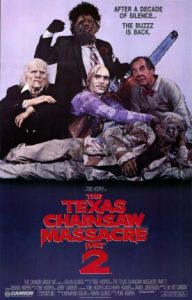 Hey, a new competitor for worst movie on this site! For some reason turning one of the best and most impactful horror movies ever made into an extended bout of broadly drawn “humor,” aggravating characterizations, little plot and no point, TCM2 is a chore to endure. Insulting in its carelessness, this flick only could have been more of a cartoon had The Mystery Machine appeared. (Much of the action takes place in an abandoned amusement park, for crying out loud. Where were the Harlem Globetrotters and Phyllis Diller?) Leatherface – sorry, “Bubba” – is reminiscent of Fred Gwynne as Herman Munster, which is not a compliment, much as Bill Moseley’s horrible character seems to have presaged alleged funnyman Jim Carrey’s equally irritating “Fire Marshall Bill.” (And in actuality was a template for Michael Keaton’s Betelgeuse.) Meanwhile, Dennis Hopper spends the first half of the film not even pretending he gives half a damn and the second half hamming it up wildly. Mr. Hooper allegedly wanted to compensate for the audience’s not recognizing the black humor in the original, but this extremely stupid and classless farce raises the question whether his first attempt was just a happy accident. Also commits the sequel’s sin of reductionism while simultaneously destroying continuity – a hapless combination. And the FX suck, too. Excruciating and disgraceful.
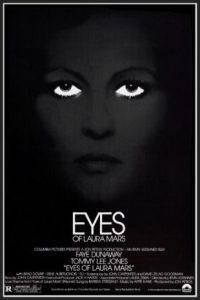 When it comes to mysteries, I’m the quintessential mark. It’s that character! No, that one! Wait, it’s probably her! Every time. How bad is it? I kept waffling about the probable identity of the killer whose dastardly exploits are viewed through Laura’s Eyes, even though this movie is 40 years old and I’ve read about it multiple times. Anyway, this production – written by John Carpenter for his first major film credit – knowingly manipulates its audience with suspenseful close-ups of René Auberjonois, our old pal Brad Dourif, the late Raúl Juliá, and other, less famous actors. Nonetheless, even a major misdirection in the late going doesn’t deter one from deducing the SHOCKING ending, especially as it’s telegraphed shortly beforehand. More “thriller” than “horror,” but it IS chock full o’ murders, death, and images thereof. The maudlin “Prisoner (Love Theme from Eyes of Laura Mars)” blares over the end credits, Barbra Streisand holding nothing back.
 Looking for some movies to watch during the MLB All-Star break, I came across this title and, as I read the synopsis and noted the release date, was flabbergasted that I’d never before even heard of the picture. Then I watched it, and the reason soon became apparent: it’s not very good. And though I’ve seen mild claims that it may have attained cult status, I don’t think I believe that revisionism, as the goings-on here can’t sustain enough appeal of any sort to induce such an outcome. Not that it isn’t entirely without merit, mind you; a murderous trio of preteens is compelling, especially as the three seem to be of perverse inclinations besides just their predilection for killing. Too much goes undeveloped, however, especially the ostensible motif of an astrological underpinning to the youths’ malevolence. The acting on display is not highly polished, either. All in all, this one comes across a little too much like a genre exploitation cheapie.
 When was the last time you saw a really dumb Hollywood spectacle? I mean D-U-M-B like Armageddon (renegades fly into space to save the Earth by landing on an asteroid and blowing it up), the 1991 Point Break (Keanu plays FBI agent Johnny Utah infiltrating a gang of bank-robbing Zen surfers), Over the Top (long-haul trucker Sly wins his son’s custody by arm wrestling) … and this one, as should be obvious from this introduction. But how does it rank in the Jurassic hierarchy, you want to know. Well, hmm, let’s see:
 When was the last time you saw a cinematic character killed by a rampaging elephant? Like, by strangling. Yeah, that’s what I thought. Wild Beasts is the kind of dubbed foreign flick that makes me wonder what the original dialogue was, although I’d be willing to bet not a whole lot of nuance is lost with translation yielding “She’s not crazy, she’s being chased by a cheetah!” and “What the hell is that! Elephants!” The production did a pretty good job with the scenes involving people being mauled by various wildlife, given obvious limitations. I’m glad I watched a murky VHS upload, however. That made the scenes featuring animal cruelty a bit easier to handle. The one in which a cat is ravaged by rats I could even believe was faked. Others, such as when lions and hyenas attack cattle and pigs inside a stockyard? No such luck. The film ends abruptly, without explaining how the zoo animals and a group of children – but apparently no one else – got dosed with PCP, despite wrapping up with a screenful of gibberish.
 One of the more perverse films you’re ever likely to see outside of niche porn, this notorious Greek exploitation picture revels in sadistic glee – often focusing directly upon said glee on the protagonists’ faces. One can only wonder the distasteful levels director (Nico) Mastorakis could have reached had this film been lensed in modern times. As it is, however, more than a few of the catalogue of murders depicted here may be somewhat difficult to stomach – literally, in the instance of the victim forced to drink paint. Honestly, as the perpetrators’ acts escalate, it sometimes feels as if the director had a list of moral or criminal offenses that he wanted to portray. [Editorial note: I just found this on IoD‘s official website: “After listing the most depraved sexual acts he could conceive, Mastorakis wrote the script in a week.”] The movie does have a working framework, however, along with an admittedly dark sense of humor, and never relents. All told, an accomplished feature debut. (Being reviled internationally IS an accomplishment.)
 FINALLY, a movie that will permit me to use the term “amanuensis” correctly. One that is basically a softcore flick with a few dodgy killings thrown in the mix, along with some largely meaningless flashbacks. Linda Hayden plays Linda Hindstatt, the amanuensis to a bestselling author, and it seems somebody has some shady secrets, or something. (Also, sex.) Various characters get “murdered” by a knife slashing at the camera or eliminated via shotgun; neither method is convincing. This potboiler was nearing its portentous conclusion by the time I realized the amanuensis was being portrayed by the very same actress who appeared as the naked teenage consort of the demon in The Blood on Satan’s Claw – which I probably shoulda realized sooner – so that was pretty exciting. The ending of this picture is not only a letdown and a cop-out, but uncreditable for various reasons, not the least of which being the immediately preceding action.
 Remember how you lived in fear of those kids at your high school who went, uh, hang gliding? You know – the ones who pushed everyone around and trashed the library. Oh, and tried to rape those weird hippie girls, and so forth. (Boy, that one kid had the grooviest custom van, though, didn’t he.) It was just such a shame about the poor kid, and the deaf one, and the fat one. Well, turns out what your school needed was a good allegory, as this excellent teensploitation film proves. A precursor to other films – scenes and characters herein must have served as inspiration for such celluloid classics as Heathers – and a predictor of symptoms of cultural decline (a kid in a TRENCH COAT perpetrates most of the mayhem in the latter half ), this production never fails to entertain. You may wonder how that’s possible at times, much as you may find the motivation of a few of the characters inscrutable, but ridiculous or not, it’ll hold your attention. Possibly its metaphorical qualities deserve the credit.
  SPACE RATS From Outer Space