directed by dulyasit niyomgul
sahamongkol film
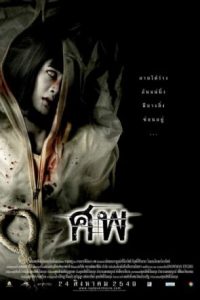 I have long wondered if one could fairly judge the quality of the acting in subtitled movies written and produced in a language not one’s own, or if the language gap and the distraction of reading the dialogue prevented accurate assessment of the performances. Well, after viewing this Thai production, I no longer wonder. No matter what the circumstances may be, it is plain Natthamonkarn Srinikornchot does not deliver good acting in the lead role. Her mien never changes much throughout the course of the picture; she seems to have only one emotional state and only one way to express it. As for the film anchored by her performance, it bears some striking similarities to The Cut – the Korean film sometimes also known as “Cadaver” – although it is by at least one measure not nearly as hard to grant credence. (On the other hand, both feature vengeful ghosts, so what am I even saying.) Both pictures also feature a coterie of young medical students, a tremulous lead female, a father figure on the faculty, and mysterious death. This one cost a lot less to make.
why did i watch this movie?
Having just watched and discussed a different Asian horror alternately called “Cadaver,” I couldn’t pass up the opportunity.
should you watch this movie?
Thailand is not often the setting for movies we see here.
highlight and low point
Pressed for an example, I’ll say the way the other characters react to Mai, the female protagonist, is pretty instructive, as they generally tolerate her at best. Some of the reasons become clearer over time, but otherwise no one seems too interested in her issues with the spirit world. The climax of this flick is inexplicably physically complicated.
 Okay. Well. The sequel to the previously discussed paragon of benevolence and good feelings Offspring, this lighthearted jest manages to outdo its predecessor in casting aspersions on the boundaries of human behavior. And that’s accomplished long before the revolting gore brightens things up. Starting its bleak portrayal of life in human society limning a few quirks and oddities, gradually revealing more depravity layer by layer and eventually producing complete incredulity, this movie is a skillful demonstration of how to achieve perfection in the art of shining a light on things your audience probably would have felt better never, ever seeing. A true sickie, horrible in almost every way by textbook definition.
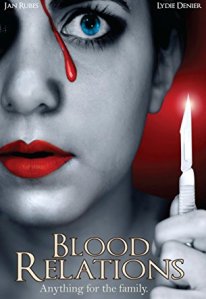 For the majority of its 90 minutes or so, this is more of a sex farce than a horror movie. Indeed, at times it reminded me of such bygone classics as Clue, as well as such bygone duds as the Sly Stallone vehicle Oscar. Numerous suspicious or threatening characters abound and … actually, all of the characters are suspicious, as it becomes increasingly more unclear who is trying to kill whom, or why. At long length, it does eventually swing into scary movie mode, but its overweening hucksterism is never superseded. It’s possible this film slipped through the cracks because it has a few moments that are too gory for what is essentially a noirish comedy of manners. As is often the case with such madcap romps, the story doesn’t wind up making a whole lot of sense, either.
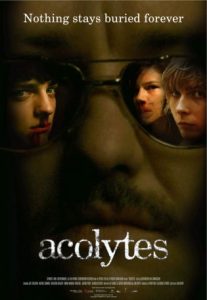 The story of three Troubled Teens – well, two of ’em, at least – who become enmeshed in a blackmail-and-murder triangle of sorts, this accomplished Australian venture turns progressively darker as it proceeds … and it starts off with a jarring, unpleasant scene. Every bit of the story seems to provide more psychological drama, which propels the narrative. The viewer is lured in further and further as the truths are revealed only bit by bit, and with a certain amount of misdirection, to boot. One of the SHOCKING twists in this one – there are several – actually is shocking, and another comes as a fairly big surprise as well. Unexpectedly good, this film succeeds largely through its portrayals of the teenagers; their complicated relationships with each other feel as though they are rendered accurately. The multifarious bait-and-switch maneuvers deftly executed by this production carry the day, however.
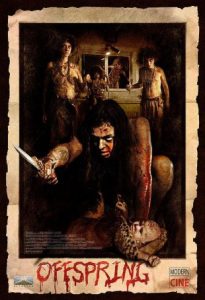 Like, wow, man. Like, I hadn’t even planned on watching this movie, but as I was about to start viewing The Woman, which I had contemplated doing for quite some time, I suddenly discovered it’s a sequel to this one, of which I had previously been unaware. And! Yikes. Allow me to take a moment here to offer an aside: Offspring novelist (and screenwriter) “Jack Ketchum” is a very, very effective purveyor of terribly unsettling material, and is in fact the author of the rare novel I did not finish because I found it too emotionally disruptive (The Girl Next Door). Nothing that occurs in this film is all that unprecedented in our filmic experience, but it is profoundly disturbing nonetheless. Ideals such as “fairness” and “justice” have no place in Ketchumland, and sometimes the action provokes a sense of outrage. It may, in some minds, border on the obscene. Anyway, this movie is about a clan of cannibals living a prehistoric tribal existence and preying on unsuspecting suburbanites. It also harbors a subplot of extreme marital discord and disharmony. Abandon all hope.
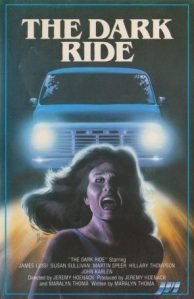 Tracking a serial killer who seems to be an amalgam of Ted Bundy and one of the Hillside Stranglers, a tough, no-nonsense cop consults a psychologist, who concocts a profile he shares with a cop buddy from a different jurisdiction. Meanwhile, trouble at home. And all these hitchhiking young girls keep turning up dead. Then some cat-and-mouse. A dangerous gambit. Finally, tough decisions; rough justice. More of a police procedural than a horror flick and largely lacking graphic detail – albeit with a scene involving nudity that seems spliced in from a different movie – it’s kind of hard to tell what was the target venue and/or audience for this one. It plays like a made-for-TV movie for the most part. The obligatory Gruff Police Captain sports some interesting haberdashery.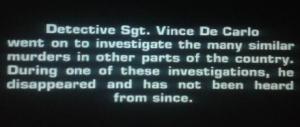
 Despite being a “found footage” tale of a largely unknown or unseen threat producing psychological torment in a five-person crew in heavily forested mountains – and with passages that directly reminded this scribe of scenes from both 2014’s Backcountry and the excellent Bob Goldthwait-helmed Bigfoot adventure Willow Creek from 2013 – this French film is often rather effective, especially as the plight of the principal female protagonist spirals out of control. The fact that no attempt is made to tie up any of the loose ends of the exposition is also a plus, aiding as it does the documentary conceit. Even the fact that the main antagonist is somewhat less impressive than presented, even underwhelming, is forgivable – until it begins to seem a bit silly. Eventually one concludes he or she has seen all this before. Which is a bit of a shame, because this is a skillfully made movie. It just doesn’t quite deliver on its promise.
 Apparently also known by the terribly baffling title Scared Alive, this is one baffling, terrible piece of filmmaking. Not only is the script lousy, and the acting, but it’s technically awful as well – a large portion of the movie takes place at night, in various dark locations, and is so poorly lit and filmed that it is often impossible to tell what is happening, or which characters are involved. At other times, it is also difficult to discern which characters are which for other reasons, leading to further confusion. During several onscreen conversations, I found myself wondering who the dialogue was referencing, being unable to place the name. (Since characters seemed to go unaccounted and reappear at random, this is perhaps not entirely my fault.) Probably not quite as bad as George Phblat’s infamous Benji Saves the Universe, but it’s gotta be close. The ridiculous murder-presaging song that plays incessantly throughout (it’s called “Face to Face”) is kinda catchy.
 Also known, in the United Kingdom at least, as Harpoon: Reykjavik Whale Watching Massacre – probably to distinguish it from all the other movies titled “Harpoon” or because “Reykjavik Whale Watching Massacre” wasn’t a descriptive enough title for a movie about a massacre that takes place during a whale-watching expedition in the waters around Iceland – RWWM is a odd little slice of bad tidings. It’s also funny, after a fashion; the term used could be “black humor” were it not quite so ill-mannered or misanthropic. Actually, one of the most interesting things about this exercise in callous, gratuitous cruelty is how the alleged humor is played – very offhandedly, for the most part. By this I mean there’s no setup and no reaction to any of the moments of presumable mirth; they’re just a part of the mélange. It’s quite an approach, and adds an appealing touch of cinéma vérité to a picture that probably doesn’t warrant it. Not as much of a feel-good film as one might expect from the uplifting title.
 Oh, man! In an earlier review I made a crack about Cannon Films, the purveyors of all sorts of cinematic treasures, and this masterpiece is from that very production studio’s defining era, when it was helmed by Menahem Golan and Yoram Globus! Imagine my delight! All right, I’ll settle down. This film, however, does possess all the hallmarks of its progenitors’ stable. It’s got replacement-level actors, including the tastefully named “Kip Niven” and the woman who played Pinky Tuscadero on Happy Days (Roz Kelly, for you trivia buffs). It also contains hilarious attempts at portraying contemporary culture, in this case “punk” and “new wave” bands and fans. (Ah, 1980.) The soundtrack alone almost defies description, particularly the title track, which possibly could sound less like “new wave” in the same manner that a jelly doughnut possibly could work less like a hammer. New Year’s Evil does, however, include one reasonably successful rendition of the SHOCKING twist – out of two, the second one being fairly predictable. A good time all around, fun for the whole family! Not really much of a horror movie in any way!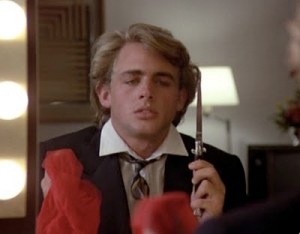
 SPACE RATS From Outer Space