directed by theodore gershuny
cannon films/jeffrey konvitz productions/armor films inc.
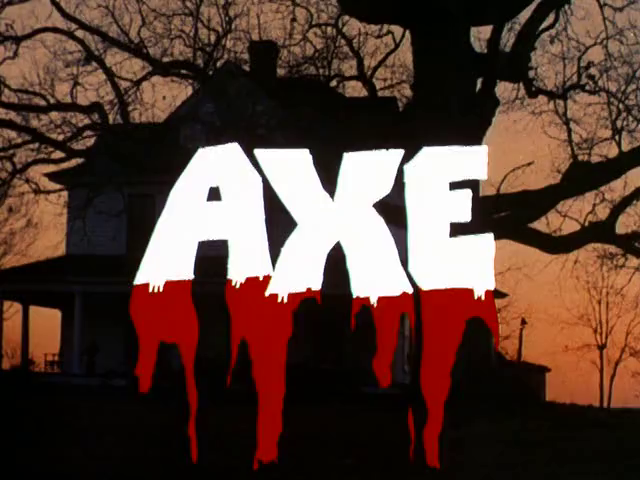
 Mainly filmed in 1970 but not finished or released until 1972, this poorly constructed, many-titled movie shows the strain of its uncertain, prolonged creation. The editing is particularly touch-and-go, as scenes hopscotch abruptly. Plus, early on, plentiful stills and freeze-frame shots dominate, sorta like in a Ken Burns documentary. Eventually the production commences with typical cinematic techniques and practices, but at a critical later juncture turns sepia tone, and subsequently seems to attempt an approach on German Expressionist territory. These latter changes are in service of flashbacks explaining the story, because someone must have realize it wasn’t coherent. Despite that, one of the characters still has to drop more knowledge on the audience more or less out of the blue. The opening and closing scenes appear to have been shot separately from the rest of the picture and appended later, and although their narration also is meant to help tie things together, it doesn’t.
why did i watch this picture?
It’s Christmas season, and the events of this film occur on Christmas Eve, as did a supposedly pivotal event 20 years earlier. (The only evidence of this is occasional background music.)
Should you watch this movie?
I cannot in good faith recommend that course of action.

highlight and low point
Even when crucial plot points are revealed, some of them still don’t make a whole lot of sense. For instance, the fact that the owner of the house around which the film is centered turned it into a mental hospital at some point, then freed the patients – blaming them for mayhem that ensued – and then spent most of the next 20 years living in a mental hospital himself, apparently by choice. Actually, that’s the linchpin of this whole muddle. Now you don’t have to watch it!
rating from outer space: D+


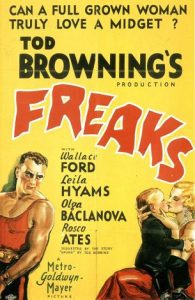 Disjointed as hell due to excessive editing undertaken in a doomed effort to make a disturbing revenge picture even somewhat palatable to a viewing public it never found, this disastrous flop remains one of Hollywood’s most ill-advised creations – for any number of reasons, not limited to how it may make its audience feel. One can only imagine how appalling the excised material must have been, and marvel as to the effect it could have added to a production that remains troubling after nearly a century. The decision to cast real circus sideshow performers was perhaps an inevitability, but the majority of them aren’t film actors and can’t much pretend to be. Saddest, though, is probably the loss of the chance to really experience the capacity for a full range of emotional responses from these morbidly maligned people, as only glimpses remain. As it is, 60-odd minutes doesn’t give anything of real resonance a real chance to coalesce, and what we’re left with often plays like a soap opera interspersed with sitcom skits. How this one ever got the green light remains a question to ponder.


 Can I call this a disappointment if I watched it thinking it would be a scuzzy, nothing exploitation slasher with paper-thin intent and slapdash execution, but instead discovered a well-crafted picture of surprising depth and real pathos made with a skillful hand? Don’t answer that, it’s a rhetorical question. But despite a number of moments that could have turned this flick into a groaner, the poignant portrayal of the title character proves redemptive. Obviously inspired by the Son of Sam killings, with a handful of details provided by other notorious murder sprees, this film’s account of title psychopath Frank’s travails leavens its less credible portions with an intermittent awareness of his humanity. (How self-aware Frank is, however, remains an open question.) Lead actor and co-writer Joe Spinell’s creation is disturbingly credible, and in context, the more fantastic notions are not hindered by their implausibility.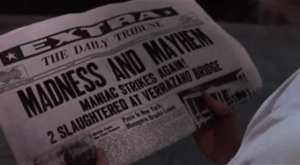


 I’ll admit it, I enjoy it a little too much – trotting out the jejune sally that “the REAL horror here is blah blah blah” and so forth – but dig it, man, that foolishness is perfectly suitable for this bonkers English presentation. Oh, don’t get me wrong, this film is for the most part shoddy and boring, but holy cats does it contain some absolutely bizarre goings-on. For one thing, it’s only around 84 minutes long, but it manages to contain a four-minute-plus lesbian scene that is frankly a lot more explicit than I would’ve supposed. For another thing, at a certain point – for no discernible reason – everything goes slo-mo as the soundtrack suddenly becomes extremely psychedelic and discordant. And no kidding, even though the story concerns a space alien who’s on Earth scouting for new “protein sources” (“spoiler”!), heavens to Murgatroyd but that isn’t the REAL horror here. I watched the climactic action of this picture jaws literally agape.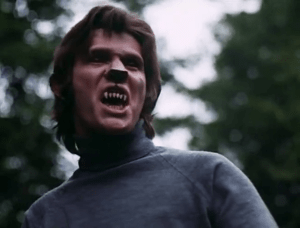
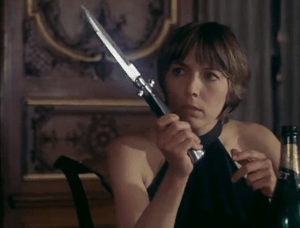
 Featured in this astounding straight-to-video accomplishment: Blatant lip-synching, awesomely generic hard rock, a mustachioed dude in a ZZ Top “Eliminator” raglan sleeve shirt, a guy in a gorilla mask breakdancing, a station named “MVTV,” chicks doing aerobics very intensely, multiple Jacuzzi scenes and one regular bathtub scene, a villain that’s a budget Mike Reno of Loverboy, a song (and character) called “
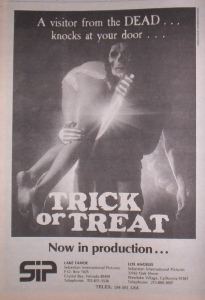 Really, though, it may have been fate: Over the opening shot of recording studio gear, the first words spoken in this picture are, “‘K, Billy, time to rock and roll – here we go.”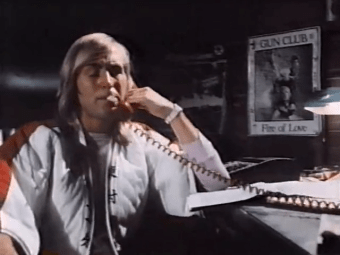
 Well now, THIS is an unpleasant little flick. I mean, nothing in this picture is going to make a viewer feel very good, unless that viewer has got some serious issues. A few things may make the viewer laugh, sure, but this is a movie that is based around psychological problems brought about by severe child abuse, which it is suggested is itself a manifestation of psychological and/or emotional disability, and which itself is manifested in cruel, ugly, sadistic, misogynistic murder. (If you doubt that description, it involves a special room clad in stainless steel.) Oh, and extreme social dysfunction is added in just for kicks. On the upside, it’s got a disco theme underlying everything, and hallucinated ambulant corpses. Effectively dismal, better than I expected, and a reminder of how much I generally seem to enjoy films from this hopeless and beaten-down time period.
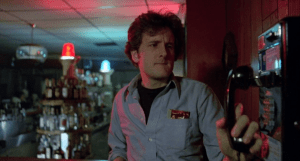 as I thought Donny the murderous lunatic’s social awkwardness was portrayed brilliantly. In fact, I generally enjoyed Bobby’s presence throughout the proceedings,
 though I remain baffled by the fact that when he believes Donny is in danger, he fetches local parson Father Gerrity and not, you know, the police.
 You know, I enjoy listing the multiple titles for some of these pix, mainly because it usually follows that the more different names a film acquires throughout its life of distribution, the more debatable its quality. There are exceptions, of course; every rule has them. This picture could be one of those exceptions. Its sobriquet may have been appended because somebody wisely decided that the original name didn’t make any sense whatsoever. Now, ’tis true that one of the characters in this patently Deliverance-derived flick makes an offhand remark – a barely audible offhand remark, mind you – that the subjects may be the victims of a demonic
  I’m going to reference it again, so let’s just go ahead with a shout-out to Hanna-Barbera: They knew what they were doing when they produced Scooby-Doo, Where Are You? You see, when viewing productions such as this somewhat lethargic attempt at a murder mystery, tropes commonplace to those cartoons continually arise. Here, dashes of occult nonsense and some bitchin’ early ’80s Southern Cal touches are added to the template. A scare or two possibly may be found somewhere in this tale of (ominous pause) madness, but you’ll most likely be too busy laughing at some of the affectations – or more probably starting to doze off as the plot chugs along repetitiously. It could have worked, I suppose, but there just isn’t a whole lot to work with, to its detriment. Oh – hackneyed freeze-frame “surprise” at the ending. Woo-hoo.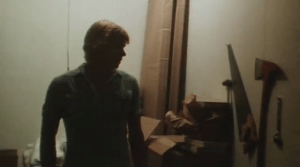
 SPACE RATS From Outer Space